Indigenous AI models from Soket Labs and ZenteiQ, built under the IndiaAI Mission, target banking, cybersecurity and offline use on mobile phones. Here’s what EKA-1 and Dhīr can do
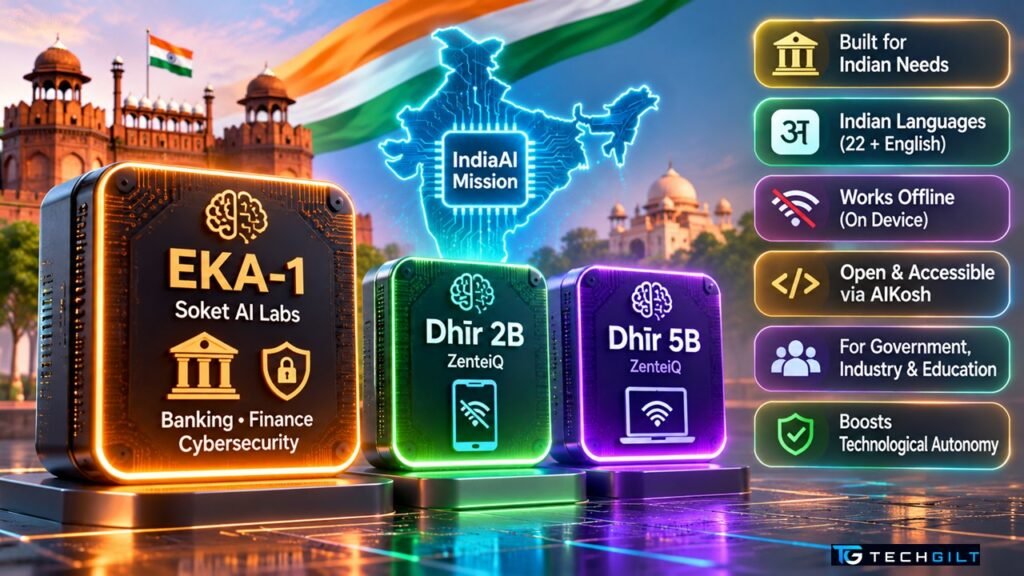
India has added three more homegrown AI models to its growing list. On November 3, 2026, the IndiaAI Mission unveiled EKA-1 from Soket AI Labs and Dhīr 2B and Dhīr 5B from ZenteiQ, three indigenous AI models designed for Indian languages and Indian needs. EKA-1 is built for banking, financial services and cybersecurity, while the smaller Dhīr models can run offline on mobile phones and on an organisation’s own servers. Coming just a week after Sarvam AI’s defence deal, the launch shows India’s push to build its own AI, from large enterprise models to lightweight ones that work without the internet. Here’s what these indigenous AI models are and why they matter.
Quick Answer
On November 3, 2026, the IndiaAI Mission released three indigenous AI models. EKA-1 by Soket AI Labs has 26.3 billion parameters, was trained on about 7.5 trillion tokens, supports all 22 scheduled Indian languages plus English, and is tailored for banking, financial services and cybersecurity. Dhīr 2B and Dhīr 5B by ZenteiQ are open-source, lightweight multilingual assistants supporting English and 10 Indian languages, designed to run on-premise and offline, including on mobile phones. The models are available to researchers, students and developers through the AIKosh platform.
The Three Indigenous AI Models at a Glance
| EKA-1 | Dhīr 2B and Dhīr 5B | |
|---|---|---|
| Developer | Soket AI Labs | ZenteiQ AiTech Innovations |
| Size | 26.3 billion parameters | Smaller, lightweight models |
| Languages | All 22 scheduled Indian languages + English | English + 10 Indian languages |
| Built for | Banking, financial services, cybersecurity | Government, defence, industry, education |
| Key strength | Maths, coding, reasoning, AI agents | Works offline, on-premise and on mobile phones |
| Openness | Described as an open model | Open-source, under licence terms |
Details as reported by Analytics India Magazine and The420.in.
EKA-1: An Indian AI Model for Banking and Cybersecurity
EKA-1 is the larger of the three indigenous AI models. Built by Soket AI Labs, it’s described as an open, sparse hybrid language model, a design that uses computing power more efficiently.
- Size: 26.3 billion parameters, trained on about 7.5 trillion tokens
- Languages: all 22 languages in the Eighth Schedule of the Constitution, plus English
- Skills: mathematics, coding, reasoning and agentic tasks (AI that can carry out multi-step actions)
- Focus: banking, financial services and cybersecurity
Soket Labs CEO Abhishek Upperwal called it “an advanced AI model specifically tailored to India’s unique banking, financial services and cybersecurity landscape.”
Dhīr 2B and 5B: AI That Works Without the Internet
Among the new indigenous AI models, the Dhīr models from ZenteiQ take a different approach: they’re small enough to run on local systems and mobile phones, with no need for a cloud connection.
- Languages: English and 10 Indian languages
- Uses: document automation, information search, and citizen and enterprise services
- Deployment: on-premise and offline, for government, defence, industry and education
- Privacy benefit: data can stay on the device instead of going to the cloud
ZenteiQ CEO Prof Sashikumar said the design “enables on-device deployment on mobile phones, without dependence on cloud connectivity.”
Why offline AI matters in India: many government offices, schools, factories and defence sites have limited or restricted internet access. AI that runs locally can work in these places and keep sensitive data in-house.
What the Government Said About Indigenous AI Models
The models were unveiled in New Delhi in the presence of MeitY Secretary S Krishnan, who said indigenous AI models would strengthen India’s technological autonomy in AI and boost productivity across government, industry, research and education.
According to Analytics India Magazine, the teams were selected under the IndiaAI Innovation Centre’s Foundation Models pillar and received subsidised national AI compute and research support from the IndiaAI Mission, which the Union Cabinet approved in March 2024.
How to Try These Indigenous AI Models
The models can be accessed by researchers, students and developers through AIKosh, the IndiaAI platform for datasets and models, according to MeitY Secretary S Krishnan. If you’re a developer or student interested in Indian-language AI, AIKosh is the place to start.
What We Don’t Know Yet About These Indigenous AI Models
According to The420.in:
- No detailed independent benchmarks have been published comparing these models with global alternatives.
- No figures on real-world deployment have been shared yet, for example whether any bank is already using EKA-1.
- Running AI locally reduces some data risks, but it doesn’t automatically make a system secure.
Why This Matters
- Sovereign AI keeps growing: after Sarvam AI’s models and defence MoU, these indigenous AI models add more homegrown options built for Indian languages.
- AI for India’s real needs: banking and cybersecurity models matter in a country facing rising digital fraud.
- AI for everyone: offline models on mobile phones could bring AI to places with poor connectivity.
- Open access: open models on AIKosh let Indian startups and students build on them.
Sarvam AI Signs Defence MoU
AI Fraud Detection in Banks
India Plans Its Own GPU Chip
Frequently Asked Questions
What are the new indigenous AI models launched by IndiaAI?
They are EKA-1 by Soket AI Labs, and Dhīr 2B and Dhīr 5B by ZenteiQ, released under the IndiaAI Mission on November 3, 2026.
What is EKA-1 used for?
EKA-1 is a 26.3-billion-parameter model supporting 22 Indian languages and English, tailored for banking, financial services and cybersecurity.
Can the Dhīr models work offline?
Yes. Dhīr 2B and Dhīr 5B are lightweight models designed to run on-premise and offline, including on mobile phones.
Are these indigenous AI models open source?
The Dhīr models are open-source under their licence terms, and EKA-1 is described as an open model. Developers can access them through the AIKosh platform.
What is the IndiaAI Mission?
It’s a government programme approved in March 2024 to build India’s AI ecosystem, including subsidised AI computing and support for indigenous foundation models.
Conclusion
The launch of EKA-1 and the Dhīr models adds three more indigenous AI models to India’s growing AI ecosystem. EKA-1 targets banking, financial services and cybersecurity with support for 22 Indian languages, while the lightweight Dhīr models bring offline, on-device AI to government, defence, industry and education. Independent benchmarks and real-world deployments will show how well they perform, but together with Sarvam’s models, they signal that India is serious about building AI that understands its languages, needs and security priorities.
My take: I believe that the introduction of EKA-1 and Dhīr is a promising step towards India’s self-reliance in artificial intelligence. It is clear that their practical focus extends to areas such as banking, cybersecurity, regional languages and offline accessibility. Small AI-powered models capable of running on smartphones can help extend the benefits of AI to regions with limited internet connectivity. This AI-driven landscape creates valuable opportunities for students, developers and startups to engage in innovation and experimentation.
However, long-term success will depend on factors such as accuracy, security, clear performance benchmarks and widespread adoption in real-world applications. I would like to conclude by saying: “India’s AI future will be stronger when technology understands not just our language, but our everyday needs.”
Over to You
Would you trust an Indian-built AI model for banking or government services? Share your thoughts in the comments below.