Fake videos of leaders, cloned voices of family members and AI-made photos are now used in scams across India. Here’s how to recognise deepfakes, check what’s real and protect yourself
A video of a top government leader announcing cash help for poor families. A phone call in your son’s voice saying he’s in trouble and needs money urgently. A photo of a celebrity endorsing an investment app. In 2026, all three can be completely fake, created in minutes with AI. These are deepfakes, and they’ve moved from internet curiosities to everyday scam tools. Just last week, the Ministry of Home Affairs warned Indians about deepfake videos of the Prime Minister and Finance Minister being used in fake welfare-scheme ads. Here’s how they work, the signs that give them away, and what to do if you come across one.
Quick Answer
Deepfakes are fake videos, images or audio created or altered with AI to look and sound real. To spot them, watch for unnatural eye blinking, lip movements that don’t match the words, blurry edges around the face, odd lighting and robotic or flat voices. More importantly, check the context: urgent requests for money, “free” government schemes, celebrity investment tips and calls from unknown numbers are major red flags. Verify through official websites or by calling the person back on a number you already know. Since February 20, 2026, India’s IT Rules require platforms to label AI-generated content and remove impersonation deepfakes within two hours of a complaint. If you’re targeted, call 1930 or report on cybercrime.gov.in.
What Are Deepfakes?
A deepfake is media made with artificial intelligence to imitate a real person or event. The name comes from “deep learning”, the type of AI used to create them. Common types include:
- Video deepfakes: a person’s face is swapped or their lips are changed to make them appear to say something they never said
- Voice clones: AI copies someone’s voice from just a few seconds of audio, then speaks any words the scammer types
- Fake images: realistic photos of events that never happened, or of real people in fake situations
- Live deepfakes: real-time face or voice changes during video calls
Creating deepfakes once needed experts and powerful computers. Today, free and cheap apps can make convincing fakes in minutes, which is why scams using deepfake technology are spreading fast.
How Deepfakes Are Being Used in Scams in India
1. Fake government scheme ads
On October 19, 2026, the Ministry of Home Affairs’ National Cybercrime Threat Analytics Unit warned about fake ads on Facebook and Instagram showing deepfake videos of the Prime Minister, the Finance Minister and Chief Ministers announcing financial help, according to ANI. Victims who respond are asked to pay “processing fees” or “taxes” again and again, or are tricked into approving UPI collect requests. The advisory noted that many calls came from +92 (Pakistan) numbers.
2. Celebrity investment tips
Deepfake videos of famous business leaders, actors or cricketers “recommending” a trading app or scheme that promises guaranteed returns.
3. “Family emergency” voice calls
A cloned voice of a child, parent or relative claims to be in an accident, arrested or stuck abroad, and asks for money immediately.
4. Fake video calls from “officials”
Scammers pose as police, CBI or customs officers on video calls, sometimes using deepfake faces or fake uniforms, as part of “digital arrest” scams.
5. Fake images to harass or blackmail
Morphed or AI-generated images of real people, often women, used for blackmail or harassment.
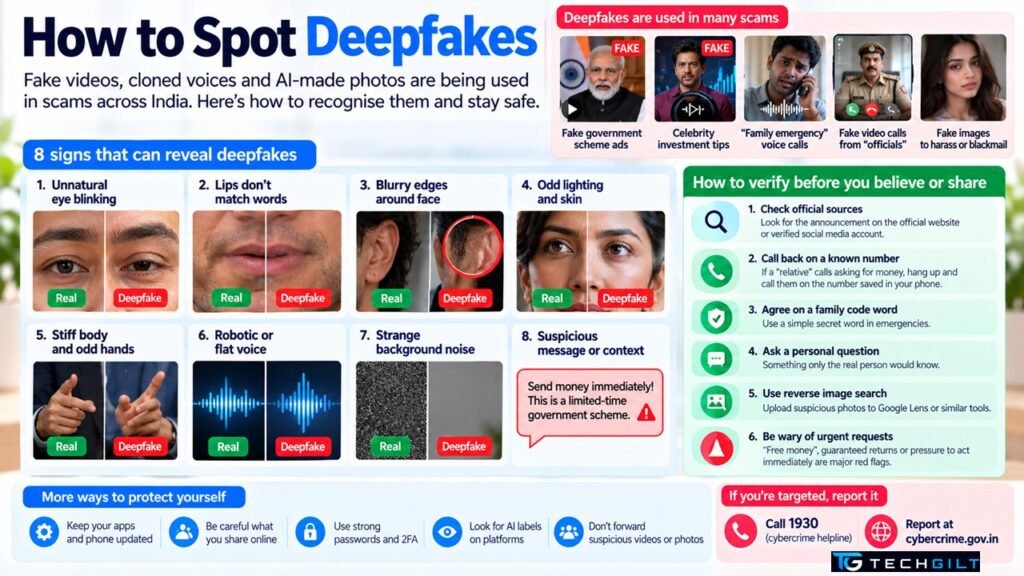
8 Signs That Can Reveal Deepfakes
AI keeps improving, so no single sign is proof. But these clues often give a fake away:
In videos:
- Eyes: unusual blinking (too much, too little or not at all) or eyes that don’t track naturally
- Lips: mouth movements that don’t quite match the words, especially on “b”, “m” and “p” sounds
- Face edges: blurring, flickering or shimmering around the hairline, ears, jaw or glasses
- Lighting and skin: shadows that don’t match the background, or skin that looks too smooth or waxy
- Body and hands: stiff head movements, odd hands or fingers, or a body that doesn’t move naturally with the face
In audio:
6. Voice: flat, robotic tone, strange pauses, or no breathing sounds
7. Background: unusually clean audio, or background noise that suddenly changes
In context (the most important):
8. The message itself: urgent money requests, “free money” offers, guaranteed returns, secrecy (“don’t tell anyone”) or pressure to act immediately
Remember: the most convincing fakes may show none of the visual signs. That’s why checking the context and verifying the source matter more than studying pixels.
How to Verify Before You Believe or Share
- Check official sources: look for the announcement on the official government website, the company’s site or the person’s verified social media account. Real schemes are never announced only through ads.
- Call back on a known number: if a “relative” calls asking for money, hang up and call them on the number saved in your phone.
- Agree on a family code word: a simple secret word that family members use in emergencies makes voice-clone scams much harder.
- Ask a personal question: something only the real person would know.
- Use reverse image search: upload a suspicious photo to Google Lens to see where it first appeared.
- Look for labels: under India’s 2026 rules, large platforms must label AI-generated content. A missing label doesn’t prove content is real, but a label is a clear warning.
- Pause before sharing: if you can’t verify it, don’t forward it.
What India’s 2026 Deepfake Rules Say
India’s IT Rules amendments, notified on February 10, 2026 and in force from February 20, 2026, directly target deepfakes, according to law firm Freshfields:
- “Synthetically generated information” covers AI-created or altered audio, images and video that look real, including deepfakes and voice clones
- Such content must be clearly and prominently labelled, and platforms must not allow labels or embedded identifiers to be removed
- Large platforms (with over 5 million Indian users) must ask users to declare AI-generated uploads and verify those declarations with technical tools
- Platforms must remove impersonation and artificially morphed images within 2 hours of a complaint, and unlawful content within 3 hours of a court or government order
- Platforms that fail these duties can lose their legal protection for user content
These rules put pressure on platforms, but scammers often operate across borders and change accounts quickly, so personal caution is still essential.
What to Do If You’re Targeted by Deepfakes
- Don’t pay or share anything: no money, OTPs, UPI PINs, Aadhaar or bank details.
- Call 1930: the National Cybercrime Helpline, especially if you’ve lost money. Speed matters.
- Report online: file a complaint at the National Cyber Crime Reporting Portal (cybercrime.gov.in).
- Report the content: use the platform’s report option for impersonation or fake content. Under the 2026 rules, impersonation content must be removed quickly.
- Report suspicious calls and messages: use Chakshu on the Sanchar Saathi portal for fraud calls and messages.
- Save evidence: take screenshots and note links, phone numbers and dates.
- Warn family and friends: especially elderly relatives, who are frequent targets.
Also read: Spot and Report UPI Scams
Frequently Asked Questions
What is a deepfake?
A deepfake is a fake video, image or audio clip made with AI to look or sound like a real person or event.
How can I tell if a video is a deepfake?
Look for unnatural blinking, mismatched lip movements, blurry face edges and odd lighting, and listen for robotic voices. Most importantly, verify the message through official sources before trusting it.
Are deepfakes illegal in India?
Using deepfakes for fraud, impersonation, harassment or defamation is illegal under existing laws. Since February 2026, India’s IT Rules also require platforms to label AI-generated content and quickly remove impersonation deepfakes.
Can someone clone my voice?
Yes. AI can copy a voice from a short audio clip, such as a social media video. Agree on a family code word and always call back on a known number before acting on urgent requests.
Where do I report deepfakes used in scams?
Call 1930 or report at cybercrime.gov.in. You can also report the content to the platform and report fraud calls on Chakshu.
Conclusion
Deepfakes have turned AI into a powerful tool for scammers, from fake government scheme ads featuring the Prime Minister to cloned voices of family members asking for money. Visual clues such as odd blinking, mismatched lips and blurry edges can help, but the strongest protection is simple: question urgent requests, verify through official sources or a known number, and never share money or OTPs under pressure. India’s 2026 rules now require labelling and fast removal of such fakes, but awareness remains your first line of defence.
My take: I believe deepfakes are among the most serious challenges of today’s fast-moving AI world, because they turn trust into a weapon. A fake video of a public figure or a cloned voice of a family member can cause fear, confusion and financial loss within minutes. We can no longer rely only on our eyes and ears to decide whether something is real. Instead, we must build the habit of verifying information before we trust it, act on it or share it.
Families should agree on a secret code word for emergencies, everyone should verify unexpected requests by calling a known, trusted number, and we should all stay alert to offers that promise “easy money” or demand immediate payment. AI can help solve many of our problems, but responsible awareness is essential to prevent its misuse. In this digital age, pausing before you trust is no longer optional; it is an essential life skill. I would conclude by saying: “In the age of deepfakes, seeing is not always believing, and verifying can protect both your money and your loved ones.”
Over to You
Have you or someone you know received a suspicious video or voice call that might have been a deepfake? Share your experience in the comments to help others stay alert.