How Indian banks use AI to spot suspicious payments in milliseconds, catch mule accounts and stop scams, and what it means for your money
Every second, millions of payments move through India’s banks and UPI apps. Somewhere among them are fraudulent ones: a stolen card, a hacked account, or money from a scam victim racing through a chain of mule accounts. No human team can check every transaction in real time. That’s why banks increasingly rely on AI fraud detection, systems that learn what “normal” looks like and raise an alarm the moment something doesn’t fit. Here’s how AI fraud detection works, how India’s banks and regulators are using it, and what it means for you as a customer.
Quick Answer
AI fraud detection uses machine learning to analyse transactions, devices and customer behaviour in real time and give each payment a risk score. Risky payments can be blocked, delayed or sent for extra verification before money leaves the account. In India, the RBI’s MuleHunter.AI, developed by the Reserve Bank Innovation Hub (RBIH), helps banks find mule accounts used to launder scam money, and it is live at more than 26 banks. The Department of Telecommunications’ Financial Fraud Risk Indicator (FRI) flags risky mobile numbers so that banks and UPI apps such as PhonePe, Paytm and Google Pay can warn users or decline payments. AI helps, but customers still need to protect their PIN, OTP and screen.
Why Banks Need AI to Fight Fraud
Fraud is still a big problem for Indian banks. According to the RBI’s annual report, reported by Business Standard, banks and financial institutions reported 10,114 fraud cases worth ₹48,021 crore in FY26. The number of cases fell by more than half, but the amount rose, partly because older cases worth over ₹30,000 crore were reported afresh.
At the same time, digital payments keep growing, and fraudsters move fast. Money stolen in a scam can pass through several accounts within minutes. Traditional fraud checks, which use fixed rules such as “flag any payment above ₹50,000”, can’t keep up. They miss new tricks and block too many genuine payments. AI fraud detection fills that gap.
How AI Fraud Detection Works
At its core, AI fraud detection asks one question for every transaction: “Does this look like this customer, and does it look safe?”
1. Learning your normal behaviour
AI models learn each customer’s usual pattern: typical amounts, times of day, locations, devices and the people they pay. A ₹500 payment at your usual grocery shop at 7 PM looks normal. A ₹49,000 transfer at 2 AM from a new phone to an account you’ve never paid before does not.
2. Real-time risk scoring
In AI fraud detection, each transaction gets a risk score in milliseconds, based on hundreds of signals, such as:
- Amount and speed: sudden large payments, or many payments in quick succession
- Device and location: a new phone, an unusual city or a mismatch between SIM and location
- Payee history: a first-time payee, or an account already linked to complaints
- Behaviour: how you type, swipe or move through the app (known as behavioural biometrics)
Low-risk payments go through instantly. High-risk ones can be blocked, held for a few hours, or need extra confirmation.
3. Spotting networks, not just transactions
Fraud often involves networks of accounts. Using graph analysis, AI fraud detection can see connections between accounts, devices and phone numbers, revealing a ring of mule accounts that looks harmless when each account is checked on its own.
4. Learning from new fraud
AI fraud detection models improve as they see new confirmed fraud cases. When scammers change tactics, the models can adapt faster than manually written rules.
MuleHunter.AI: India’s Weapon Against Mule Accounts
A mule account is a bank account used to receive and move money from illegal activities. As Business Standard explains, account holders are often lured through fake jobs, loan offers or social media, and some don’t even know their account is being misused. The Indian Cybercrime Coordination Centre (I4C) had flagged more than 2.47 million first-layer mule accounts by early 2026.
To tackle this, the RBI introduced MuleHunter.AI, an AI and machine learning platform developed by the Reserve Bank Innovation Hub (RBIH). It analyses transaction patterns and account behaviour to flag likely mule accounts, so banks can act before scam money disappears.
Key developments in 2026:
- More than 26 banks now use MuleHunter.AI, and it is being expanded further.
- In May 2026, the Finance Ministry asked banks to adopt it “at the earliest”, according to Outlook Money.
- On May 12, 2026, I4C and RBIH signed an MoU to share suspect identifiers from the National Suspect Registry and the National Cybercrime Reporting Portal with MuleHunter.AI, according to Clearing Post.
This matters because almost every online scam, from fake KYC calls to investment frauds, needs mule accounts to move and cash out money. Cut off the mule accounts, and scams become much harder to profit from.
Financial Fraud Risk Indicator: Flagging Risky Phone Numbers
AI fraud detection works best when banks can see data beyond their own systems. The Department of Telecommunications launched the Financial Fraud Risk Indicator (FRI) in May 2025, as part of its Digital Intelligence Platform.
According to Voice&Data, FRI classifies mobile numbers as Medium, High or Very High fraud risk, using data from the National Cybercrime Reporting Portal, the Chakshu reporting facility and bank intelligence.
- PhonePe was among the first to use it, blocking payments involving Very High-risk numbers and warning users
- Paytm and Google Pay are also implementing these alerts
- Several banks use FRI data to strengthen their own fraud checks
So when you see a warning like “This number has been reported for fraud” before paying, that’s this kind of intelligence at work.
Where Else Banks Use AI Fraud Detection
- Card fraud: spotting unusual card use, such as an overseas purchase minutes after a local one
- Loan and KYC fraud: detecting fake or edited documents and synthetic identities
- Phishing and scam calls: analysing messages and links to warn customers about scams
- Deepfake and voice fraud: checking for AI-generated voices or faces in video KYC and phone banking
- Insider fraud: flagging unusual activity by employees with system access
The Limits of AI Fraud Detection
AI fraud detection is powerful, but it isn’t perfect:
- False alarms: genuine payments are sometimes blocked, which frustrates customers. Banks have to balance safety and convenience.
- “Authorised” scams are hard to stop: if a customer is tricked into sending money themselves, the payment can look normal to the system.
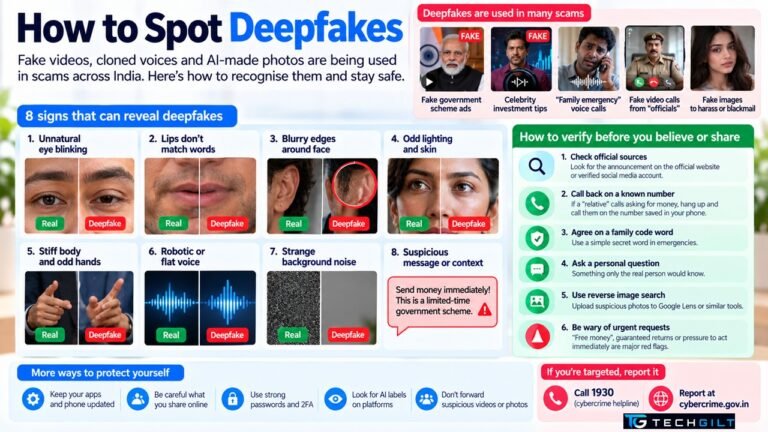
- Criminals use AI too: scammers use AI for convincing messages, cloned voices and fake documents, so detection must keep improving. Learn how to spot them in our guide: How to Spot Deepfakes.
- Data quality matters: AI is only as good as the data it learns from, and fraud data is spread across banks, telecom companies and police.
- Privacy and fairness: banks must use customer data responsibly and make sure models don’t unfairly block particular groups of customers.
What This Means for You
AI fraud detection works quietly in the background, but you’re still the first line of defence:
- Don’t ignore warnings. If your UPI app or bank says a number or account is risky, stop and verify.
- Expect occasional checks. A bank call or extra OTP for an unusual payment is a sign the system is working.
- Never share your PIN, OTP or screen. AI can’t protect a payment you approve yourself.
- Never lend your bank account. Letting someone use your account for “commission” can make you part of a mule network, with serious legal consequences.
- Report fraud fast. Call 1930 or report on the National Cyber Crime Reporting Portal immediately.
Also read: Spot and Report UPI Scams
Frequently Asked Questions
What is AI fraud detection in banking?
AI fraud detection uses machine learning to analyse transactions, devices and behaviour in real time, giving each payment a risk score so that suspicious ones can be blocked or verified.
What is MuleHunter.AI?
MuleHunter.AI is an AI platform developed by the Reserve Bank Innovation Hub to help banks identify mule accounts used to move money from scams. It is live at more than 26 banks.
What is a mule account?
A bank account used to receive and transfer money from illegal activities. Holders are often lured through fake jobs or commission offers, and letting others use your account can lead to legal trouble.
Can AI stop all bank fraud?
No. AI greatly reduces fraud, but scams where customers are tricked into approving payments themselves are harder to stop, so awareness remains essential.
Why did my bank block a genuine payment?
AI fraud detection may flag a payment that looks unusual, such as a large amount, a new payee or a new device. Verifying it with your bank usually releases it.
Conclusion
AI fraud detection has become one of the most important tools Indian banks have against fraud. By learning each customer’s normal behaviour, scoring every payment in milliseconds and spotting hidden networks, it catches fraud that fixed rules miss. National efforts such as the RBI’s MuleHunter.AI and DoT’s Financial Fraud Risk Indicator are connecting banks, telecom data and police intelligence to target mule accounts and risky numbers. But AI is not a replacement for caution: banks must keep improving their models, and customers must still protect their PIN, OTP and accounts.
My take: I believe AI fraud detection is becoming one of the most critical security layers in India’s digital banking system. It can analyse thousands of signals in milliseconds, identify suspicious transactions and help banks uncover networks of mule accounts before more money is lost. However, technology alone cannot eliminate fraud. Fraudsters keep changing their tactics, and even the most sophisticated AI system can be beaten when a victim is tricked into approving a payment. In my view, the strongest defence comes from combining intelligent banking systems, close collaboration between banks, telecom providers and law enforcement, and well-informed customers.
As digital payments become part of our daily lives, convenience should never come at the expense of caution. Before sending money to someone you don’t know, pause, verify the recipient and take every fraud warning seriously. Never share your PIN or OTP, and if you suspect fraud, call 1930 and report it on the National Cyber Crime Reporting Portal as soon as possible. I would conclude by saying: “In digital banking, AI may be your first line of defence, but your awareness remains your strongest shield.”
Over to You
Has your bank or UPI app ever blocked a payment or warned you about a risky account? Share your experience in the comments below.