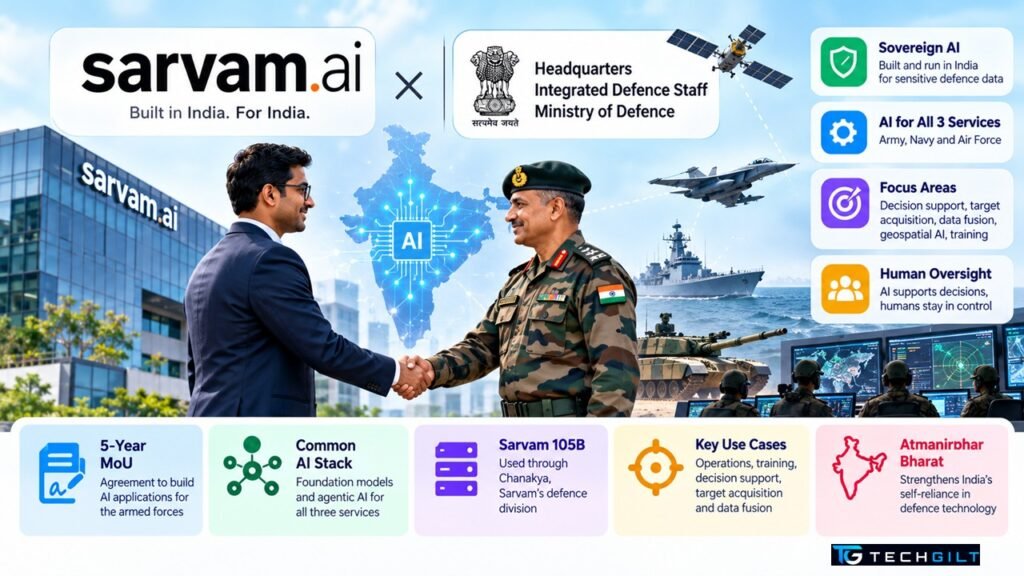
Bengaluru’s Sarvam AI will build made-in-India AI for the Army, Navy and Air Force under a new pact with the Defence Ministry. Here’s what the deal covers and why it matters
India’s armed forces are turning to a homegrown AI company to build their next generation of digital tools. On October 27, 2026, Sarvam AI announced a Memorandum of Understanding (MoU) with Headquarters Integrated Defence Staff (HQ IDS), part of the Ministry of Defence, to design, develop and deploy AI applications for the Army, Navy and Air Force. The systems will run on sovereign infrastructure in India, keeping sensitive military data under Indian control. Here’s what the deal covers, how Sarvam got here, and why it matters for India’s AI ambitions.
Quick Answer
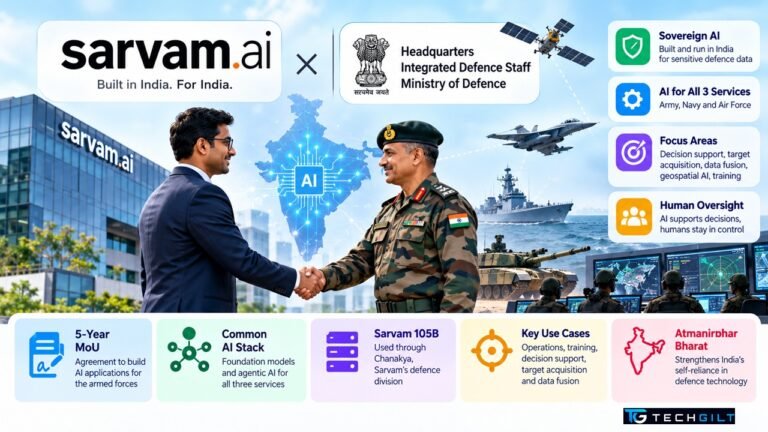
Sarvam AI has signed an MoU with HQ Integrated Defence Staff under the Ministry of Defence to build AI applications for all three armed forces. According to NewsBytes, it is a five-year agreement. The work covers operations, training and decision support, including target acquisition and data fusion, with humans keeping oversight of operational decisions. It will be handled by Chanakya, Sarvam’s firewalled defence division, using its Sarvam 105B foundation model. Financial terms have not been disclosed.
What the Sarvam AI Defence MoU Covers
According to Telangana Today, the MoU allows Sarvam to work on several projects across the three services, as well as joint and tri-service organisations under HQ IDS. The key focus areas are:
- Decision support: helping commanders analyse large amounts of information faster
- Target acquisition: using AI to identify and track potential targets
- Data fusion: combining data from different sensors across the “sensor-to-shooter” chain, with human oversight on operational decisions
- Geospatial and perception systems: AI that understands maps, satellite images and surroundings
- Training and knowledge management: making military knowledge and lessons easier to search and use
All three services will share a common technology stack of foundation models and agentic AI infrastructure, so that lessons learned in one project can be reused in others.
Why “Sovereign AI” Matters for Defence
Defence data is among the most sensitive information any country holds. As Elets CIO notes, operational military data cannot be sent through AI models or platforms hosted abroad. That’s why the deal stresses sovereign AI: AI systems designed, built and run in India, on Indian infrastructure, under Indian control.
This also fits the government’s push for Atmanirbharta (self-reliance) in defence. Just as India is building its own fighter jets, missiles and drones, it now wants its own AI.
Who Is Sarvam AI?
Sarvam AI is a Bengaluru-based AI company founded in August 2023 by Vivek Raghavan and Pratyush Kumar, who previously worked on AI4Bharat at IIT Madras.
Key milestones:
- December 2023: raised about $41 million in funding led by Lightspeed, with Peak XV Partners and Khosla Ventures
- April 2025: selected under the government’s IndiaAI Mission to build India’s own foundational AI model
- February 2026: unveiled the Sarvam 30B and Sarvam 105B models at the AI Impact Summit in New Delhi, and later released them as open source
- February 2026: launched Indus, its AI chat app, built on the 105B model
Sarvam already has a defence connection. DRONA 2.0, an AI system rolled out at the Defence Services Staff College (DSSC), Wellington, earlier in 2026, combines Sarvam’s 105B model with open-source models for military education and research.
What Sarvam AI Said
Co-founder Pratyush Kumar said Sarvam “exists to build AI in India, for India”, and called the opportunity to work with the three services on the nation’s defence “an honour and a privilege”.
Why This Deal Matters
- A big vote of confidence in Indian AI: the armed forces are trusting an Indian startup, not a foreign tech giant, with sensitive AI work.
- A test bed for sovereign AI: if it works in defence, the same approach could be used in other critical sectors such as banking, health and power.
- Faster decisions: AI can help analyse huge amounts of sensor and intelligence data in seconds.
- Questions to answer: using AI in military targeting raises important questions about accuracy, accountability and ethics. The emphasis on human oversight will be closely watched.
Gemini 4 Argon Launched
How to Spot Deepfakes
Frequently Asked Questions
What is the Sarvam AI defence MoU?
It is an agreement between Sarvam AI and HQ Integrated Defence Staff, under the Ministry of Defence, to build AI applications for the Army, Navy and Air Force.
How long is the agreement?
According to NewsBytes, it is a five-year MoU. Financial terms have not been disclosed.
Which AI model will Sarvam use?
The work will use Sarvam’s AI stack, including its Sarvam 105B foundation model, through its defence division, Chanakya.
What is sovereign AI?
Sovereign AI means AI systems built, hosted and controlled within a country, so that sensitive data stays under that country’s control.
Will AI make military decisions on its own?
No. Reports say humans will keep oversight of operational decisions.
Conclusion
Sarvam AI’s MoU with the Defence Ministry is a milestone for India’s homegrown AI industry. Using its Sarvam 105B model and a dedicated defence division, the company will build AI for decision support, target acquisition, data fusion and training across the Army, Navy and Air Force, all on sovereign Indian infrastructure. The deal reflects India’s push for self-reliance in both defence and AI. Its success will depend on accuracy, security and strong human oversight, but it could become a model for how India builds trusted AI for its most critical sectors.
My take: I believe Sarvam AI’s MoU with India’s Ministry of Defence is a significant opportunity for India to strengthen its capabilities in both artificial intelligence and national security. In today’s world, AI is far more than a business tool. It is becoming vital for analysing information, supporting decisions and protecting critical infrastructure. Building this capability through an Indian company, on infrastructure under Indian control, will help India reduce its reliance on foreign AI platforms for sensitive defence applications.
However, building sovereign AI is only the first step. The technology must be accurate, secure, reliable and thoroughly tested in real-world conditions. Most importantly, AI should support military personnel, not replace human judgement in critical operational decisions. If implemented responsibly, this partnership could improve India’s security preparedness and set an example for trusted AI in other critical sectors, including banking, healthcare and energy. India’s goal is not merely to build its own AI, but to build AI the nation can trust. I would conclude by saying: “India’s AI future will be measured not only by how intelligent its systems become, but by how securely and responsibly the nation can trust them.”
Over to You
Should India rely on homegrown AI companies like Sarvam AI for defence and other critical sectors? Share your thoughts in the comments below.