India wants an indigenous GPU within 24 months under Semicon 2.0, as the government opens applications for chip equipment, fabs and packaging units. Here’s what the plan means for India’s AI future
India wants to build the chips that power artificial intelligence, not just use them. MeitY Secretary S. Krishnan has said India aims to develop an indigenous GPU (graphics processing unit) in about 24 months under the second phase of the India Semiconductor Mission (ISM 2.0, or Semicon 2.0). Days later, on November 6, 2026, IT Minister Ashwini Vaishnaw launched the Semicon 2.0 application portal and announced 12 new electronics component projects worth ₹7,503 crore. Together, these moves show India trying to own more of the AI hardware stack, from chips to factories. Here’s what was announced and why it matters.
Quick Answer
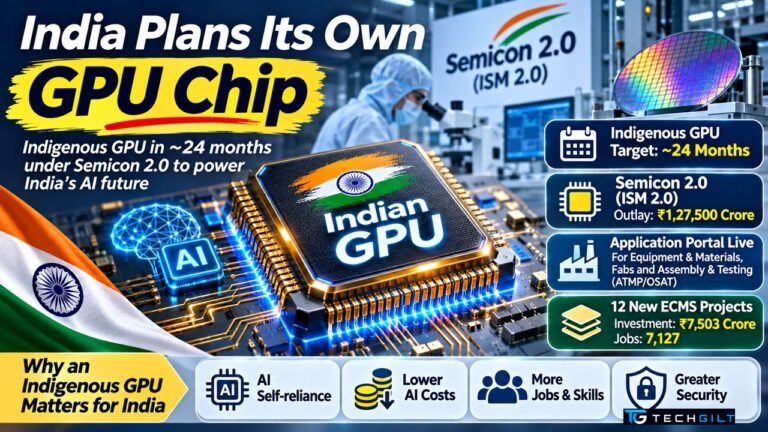
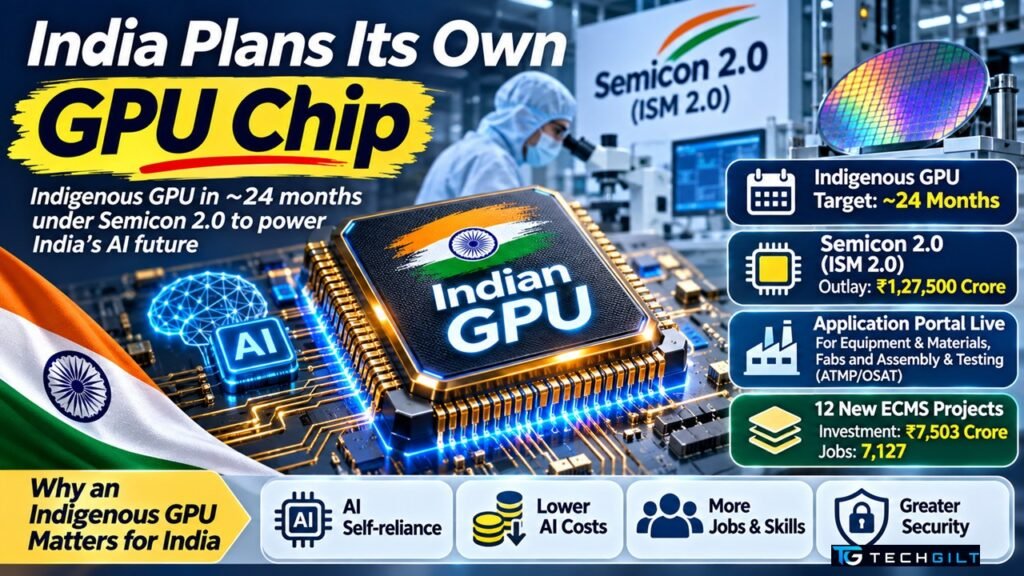
India plans to develop an indigenous GPU in about 24 months under Semicon 2.0, according to MeitY Secretary S. Krishnan. No manufacturer, architecture or launch date has been named yet, though Minister Vaishnaw says the GPU roadmap “is getting finalised.” Semicon 2.0 has a fiscal outlay of ₹1,27,500 crore, and its application portal went live on November 6, 2026 for semiconductor equipment and materials, chip fabs, and assembly and testing (ATMP/OSAT) units. The government also approved 12 more projects under the Electronics Components Manufacturing Scheme (ECMS), worth ₹7,503 crore and expected to create 7,127 direct jobs.
What Is a GPU, and Why Does India Want One?
A GPU was originally designed to handle graphics in games and videos. Today, GPUs are the engines behind AI. Training and running models like ChatGPT, Gemini or India’s own Sarvam and EKA-1 needs thousands of these chips working together.
Right now, almost all AI GPUs come from a few foreign companies, and global supply has been tight, with prices rising. For India, that creates three problems:
- Cost: buying imported GPUs at scale is very expensive.
- Supply risk: shortages or export rules elsewhere can slow India’s AI plans.
- Sovereignty: sensitive government, defence and banking AI workloads are safer on hardware India controls.
That’s why an indigenous GPU has become a priority under India’s sovereign AI push.
What MeitY Secretary S. Krishnan Said
In an interview published on November 4, Krishnan said India should have “a GPU chip of our own” and that the project would need approximately 24 months. Key points, as reported by Elets CIO and IANS:
- The indigenous GPU will be developed under ISM 2.0 / Semicon 2.0.
- The 24-month timeline is a development target, not a confirmed commercial launch date.
- No manufacturer, chip architecture or specifications have been named yet.
- India also plans to commercialise its own processors, SHAKTI and VEGA, which are based on the open RISC-V design.
- Krishnan listed five building blocks of AI: energy, accelerator chips, computing infrastructure and servers, AI models, and applications.
Semicon 2.0: The Portal Is Now Live
On November 6, Vaishnaw launched the Semicon 2.0 web application portal, according to the official PIB release. Companies can now apply under three of its six pillars:
| Semicon 2.0 pillar | Applications open? |
|---|---|
| Chip design | Not yet |
| Equipment, materials, chemicals and gases | Yes |
| Semiconductor fabs | Yes |
| Assembly and testing (ATMP/OSAT) | Yes |
| Research and development | Not yet |
| Talent development | Not yet |
Semicon 2.0 has a fiscal outlay of ₹1,27,500 crore. Vaishnaw said it aims to build domestic capability in equipment, materials, chemicals and gases, and to attract major global suppliers to India.
How Far Has India Come So Far?
Under Semicon 1.0, the first phase of the programme:
- 12 semiconductor projects were approved across six states.
- Total investment exceeded ₹1.64 lakh crore.
- Five projects had started commercial production by October 2026.
12 New Electronics Component Projects
Alongside the portal, MeitY approved 12 more applications under ECMS, as reported by DD India:
- Investment: ₹7,503 crore
- Direct jobs: 7,127
- States: Gujarat, Karnataka, Madhya Pradesh, Maharashtra, Punjab, Tamil Nadu and Uttar Pradesh
- First-time products: copper foil, cathode active material and specialty ceramics
- Total ECMS approvals so far: 118, covering 34 products across 16 states
Why an Indigenous GPU Matters for India
- AI self-reliance: together with homegrown models like EKA-1, Dhīr and Sarvam’s models, an indigenous GPU would complete the sovereign AI stack.
- Lower costs over time: local chips could eventually reduce the cost of AI computing for startups, researchers and government projects.
- Jobs and skills: chip design, verification and manufacturing create high-skill jobs. India already has a large share of the world’s chip design engineers.
- Security: defence, banking and government AI can run on hardware India controls.
The Challenges
Building a competitive indigenous GPU is one of the hardest tasks in technology. Leading AI chips take years of design work, advanced manufacturing that India doesn’t yet have at scale, and a mature software ecosystem that developers trust. A first indigenous GPU may not match the world’s top AI chips straight away. The real test will be whether it’s good enough, and affordable enough, for Indian AI workloads.
IndiaAI Launches 3 AI Models
Sarvam AI Signs Defence MoU
Frequently Asked Questions
Is India making its own GPU?
Yes. MeitY Secretary S. Krishnan has said India aims to develop an indigenous GPU in about 24 months under Semicon 2.0. No manufacturer or chip design has been named yet.
What is Semicon 2.0?
Semicon 2.0 is the second phase of the India Semiconductor Mission, with a fiscal outlay of ₹1,27,500 crore. It covers chip design, equipment and materials, fabs, assembly and testing, R&D and talent.
When will India’s indigenous GPU be ready?
The government’s target is about 24 months, but this is a development goal rather than a confirmed launch date.
What are SHAKTI and VEGA?
They are India-developed processors based on the open RISC-V architecture. The government plans to commercialise them.
What is ECMS?
The Electronics Components Manufacturing Scheme supports local production of electronic components. With the latest 12 approvals, it now covers 118 projects across 16 states.
Conclusion
India’s plan for an indigenous GPU in 24 months is ambitious, and the launch of the Semicon 2.0 portal shows the government is moving from announcements to applications. With ₹1.27 lakh crore set aside, five Semicon 1.0 projects already in production and new component plants on the way, the foundation is getting stronger. Whether India can design an indigenous GPU that’s competitive for real AI work is the big question for the next two years.
My take: Developing a domestic GPU is an important step towards strengthening India’s technological self-reliance. As artificial intelligence advances, access to computing hardware is becoming just as important as developing AI models. An indigenous GPU could enhance capabilities across AI research, defence, banking and other critical sectors. The initiative is particularly significant because it involves investment in semiconductor manufacturing, components and skilled engineering talent. However, building a competitive GPU is challenging, and success will depend on performance, accessibility and software support. India must focus on creating a sustainable technology ecosystem. To sum up: “The nation that builds its own AI hardware will have greater control over its technological future.”
Over to You
Do you think India can build a competitive AI chip in two years? Share your view in the comments below.