A digital arrest scam uses fake police, CBI or customs officers on video calls to frighten you into paying. Here’s how it works, the warning signs and exactly what to do if you get such a call
“Your Aadhaar has been linked to a drugs parcel. Stay on this video call. You are under digital arrest.” Thousands of Indians have heard words like these, and many have lost their life savings.
A digital arrest scam is a cybercrime in which fraudsters pretend to be police, CBI, ED, customs or RBI officials, keep the victim on a video call for hours and force them to transfer money to “clear their name”. According to a status report filed by I4C and the Home Ministry in the Supreme Court, more than 21,900 complaints involving over ₹647 crore were registered between January and August 2026 alone. This guide explains how the scam works and how to protect yourself and your family.
Quick Answer
A digital arrest scam is fake. No Indian law allows anyone to be arrested over a phone or video call, and no real officer will ask you to transfer money to prove your innocence. If you get such a call: hang up, don’t share any details or OTPs, don’t transfer money, talk to a family member, and report it immediately on the national cybercrime helpline 1930 or at cybercrime.gov.in. You can also report the number on Chakshu (sancharsaathi.gov.in/sfc). If you’ve already paid, call 1930 straight away, because reporting quickly improves the chance of freezing the money.
What Is a Digital Arrest Scam?
In a digital arrest scam, criminals pose as officers from agencies such as the CBI, ED, NCB, police, customs, TRAI or RBI. They claim you’re involved in a serious crime, such as drug trafficking, money laundering or a fake passport case. Then they say you are under “digital arrest” and must stay on a video call until the “investigation” is over.
The word “arrest” is the trick. There is no such thing as a digital arrest in Indian law. Real police don’t arrest people over WhatsApp or Skype, and they never ask for money to be transferred to a “safe” or “verification” account.
How the Digital Arrest Scam Works
Most cases follow a similar script:
- The first call: someone claims to be from a courier company, TRAI or a bank. They say a parcel in your name contains drugs, or your SIM or Aadhaar is linked to a crime.
- The transfer to “police”: the call is passed to a fake police or CBI officer, who switches to a video call. They may wear a uniform and sit in a room made to look like a police station.
- Fake documents: they show fake arrest warrants, court orders or letters with your name, photo and Aadhaar details, often taken from leaked data.
- Isolation: you’re told not to tell anyone, not to disconnect and to stay on camera, sometimes for hours or even days.
- The demand: to “verify” your money or avoid arrest, you’re told to transfer your savings, FDs or loan money to a “secure government account”. In reality, it’s a mule account controlled by the gang.
- They disappear: once the money is sent, the scammers vanish and the money is quickly moved through many accounts.
According to I4C data cited by the Observer Research Foundation, nearly 46% of these operations originate in Cambodia, Myanmar and Laos, run by organised cross-border gangs.
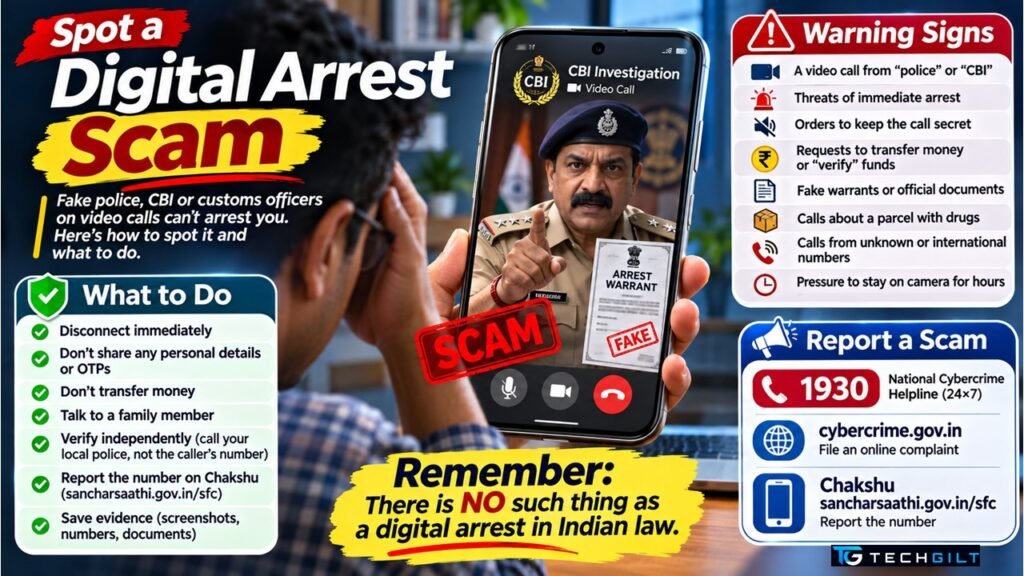
8 Warning Signs of a Digital Arrest Scam
Watch out for these red flags:
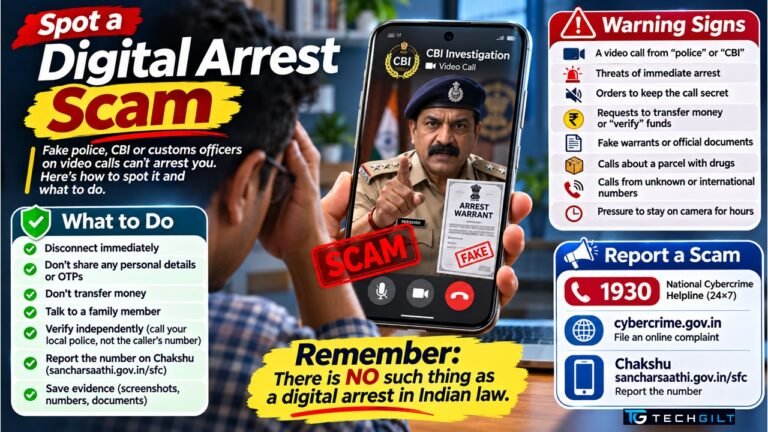
- A video call from “police” or “CBI”: real agencies don’t investigate or arrest over video calls.
- Threats of immediate arrest unless you act right now.
- Orders to keep the call secret from family, friends or your bank.
- Requests to transfer money to “verify” it, as a “security deposit” or to a “safe account”.
- Fake documents sent over WhatsApp, such as warrants with official-looking logos and stamps.
- Calls about a parcel with drugs or illegal items you never sent.
- Calls from unknown or international numbers, sometimes disguised to look Indian.
- Pressure to stay on camera for hours without a break.
If you notice even one of these, it’s almost certainly a digital arrest scam.
What to Do If You Get a Digital Arrest Call
- Disconnect immediately. You don’t owe the caller any explanation.
- Don’t share anything: no Aadhaar, PAN, bank details, OTPs or screenshots of your accounts.
- Don’t transfer money, whatever the threat.
- Talk to someone you trust. Every digital arrest scam relies on fear and isolation. One conversation with a family member usually breaks the spell.
- Verify independently. If you’re worried, call your local police station using a number you look up yourself, not one the caller gives you.
- Report the number on Sanchar Saathi Chakshu and call 1930.
- Save evidence: take screenshots, note phone numbers and keep any documents sent to you.
If You’ve Already Lost Money
Act fast. In a digital arrest scam, the first few hours matter most.
- Call 1930 (the national cybercrime helpline) immediately, or file a complaint at cybercrime.gov.in.
- Call your bank and ask them to block further transactions and flag the transfer as fraud.
- Share details: the amount, time, transaction IDs and the accounts you paid into.
- File a police complaint at your nearest police or cyber crime station.
- Change passwords for net banking, email and UPI apps, especially if you shared any details.
Quick reporting through 1930 lets banks try to freeze the money before it moves further.
What the Government Is Doing
The digital arrest scam is now a national priority:
- Supreme Court: the court is hearing a case on digital arrest fraud and has directed the CBI to investigate cases involving ₹10 crore or more, according to Free Press Journal.
- Blocking accounts: I4C and the Home Ministry have blocked over 83,000 WhatsApp accounts and around 7.8 lakh SIM cards linked to these scams.
- Banking safeguards: the RBI is reportedly considering extra safeguards, such as delayed credits for suspicious transfers, to give victims time to stop payments.
How to Protect Elderly Family Members
Many victims are senior citizens living alone or retired professionals with savings. Take five minutes to:
- Explain the scam in simple words: “Police never arrest anyone on a video call.”
- Agree on a rule: any call about arrests or money must be discussed with family first.
- Save 1930 in their phone and show them how to report.
- Set lower transaction limits on their bank and UPI apps.
Spot and Report UPI Scams
How to Spot Deepfakes
Frequently Asked Questions
Is digital arrest legal in India?
No. There’s no provision for “digital arrest” in Indian law. No police officer or government agency can arrest you over a phone or video call.
What should I do if I get a digital arrest call?
Hang up, don’t share details or transfer money, speak to a family member and report the call on 1930 or cybercrime.gov.in.
Can I get my money back after a digital arrest scam?
Sometimes. If you report quickly on 1930, banks may be able to freeze the money before it’s withdrawn. The sooner you report, the better your chances.
Why do digital arrest scammers know my personal details?
They often use data from leaks and breaches, such as your name, address or Aadhaar number, to make their claims look real. Knowing your details doesn’t make them genuine.
Who should I call to report a digital arrest scam?
Call the national cybercrime helpline 1930, report at cybercrime.gov.in, and report the scam number on the Sanchar Saathi Chakshu portal.
Conclusion
The digital arrest scam works because it uses fear, authority and isolation to rush people into paying. The defence is simple: remember that no real officer arrests anyone over a video call, never transfer money under pressure, talk to your family and report the call on 1930. Share this guide with your parents and grandparents. A two-minute conversation today could save someone’s life savings tomorrow.
My take: Digital arrest fraud is among the most dangerous forms of cybercrime because it exploits both technology and human emotions. Scammers create panic, impersonate trusted officials and isolate victims from their families to steal money. What is most concerning is that even educated and financially aware individuals can fall victim when fear overrides judgement. Awareness remains the strongest defence. Families should openly discuss these scams, especially with elderly members, and remember one important rule: never transfer money simply because someone issues threats over a phone or video call. My message to every reader is simple: “Never let fear make a financial decision for you. A genuine authority will never demand money to prove your innocence.”
Over to You
Have you or someone you know received a digital arrest call? Share your experience in the comments to help others stay alert.