The AU Bank data leak: AU Small Finance Bank is investigating a potential leak after hackers claimed to have customers’ KYC and loan data. Here’s what we know, what’s unconfirmed, and how to protect yourself
Another Indian financial company is dealing with a possible data breach. AU Small Finance Bank has confirmed it is investigating a potential data leak involving a third-party software platform that holds data on its vehicle loan customers, after a hacker group claimed on the dark web to have stolen sensitive records, including Aadhaar, PAN and loan documents. In a separate claim the same week, a hacker said they were selling administrator access to the systems of electronics retailer Vijay Sales. Neither breach has been independently confirmed. Here’s what we know about the AU Bank data leak, what’s still unclear, and the steps you should take now if you’re a customer.
Quick Answer
In the AU Bank data leak case, on October 29–30, 2026, a hacker group calling itself “ScarlettGroup” claimed on its leak site to have data from AU Small Finance Bank, including KYC records, PAN and Aadhaar details, credit reports, bank statements and signed loan agreements. AU Bank said it is investigating a potential data leak involving a software-as-a-service (SaaS) platform hosted by Salesforce that holds “limited data relating to our vehicle loan customers”, and that its own banking systems are unaffected. Salesforce said it has no sign that its platform was compromised. The claims in the AU Bank data leak haven’t been independently verified.
If you’re an AU Bank vehicle loan customer, watch for fake calls and messages about your loan or KYC, never share OTPs, and consider locking your Aadhaar biometrics.
What Happened in the AU Bank Data Leak
The AU Bank data leak claims first appeared online last week. According to ThePrint, the claims surfaced on Thursday, October 29, when a cybersecurity account on X flagged a post by ScarlettGroup. The group runs a dark web leak site where it lists victims and threatens to publish data if they don’t pay.
According to the hackers, the AU Bank data leak includes:
- KYC records, including PAN and Aadhaar details
- Credit reports and bank statements
- Loan applications and signed loan agreements
- Insurance records and CRM (customer management) data
- Employee information, login histories and audit logs
According to MediaNama, the listing was marked “in negotiation” with a countdown timer, a common pressure tactic used by ransomware and extortion groups.
What AU Bank Said About the Data Leak
AU Bank’s spokesperson said the bank is “investigating a potential data leak involving a software-as-a-service (SaaS) platform”, which is “managed and hosted by Salesforce, which holds limited data relating to our vehicle loan customers.”
The bank added: “We reaffirm that the Bank’s own systems remain unaffected and all banking services are operating normally.”
Important context on the AU Bank data leak, according to ThePrint:
- AU Bank partnered with Salesforce in March 2024 to digitise vehicle loan onboarding.
- AU’s vehicle loan business serves over 13.7 lakh customers.
- The bank hasn’t said how many customers may be affected.
- Salesforce said it has no sign that its own platform was compromised, and that it refuses to pay hackers.
The Vijay Sales Claim
In a separate incident reported the same week as the AU Bank data leak, a different threat actor claimed to be selling administrator access to Vijay Sales’ systems for $25,000, according to Inc42. According to Digit, the seller claimed access to over 3 million order records, data on about 15,000 employees and billing records for around 1.4 lakh vendors.
Vijay Sales had not confirmed a breach at the time of these reports.
AU Bank Data Leak: What’s Confirmed vs Unconfirmed
| Status | |
|---|---|
| AU Bank is investigating a potential data leak | ✅ Confirmed by the bank |
| The affected platform holds limited vehicle loan customer data | ✅ Confirmed by the bank |
| AU Bank’s core banking systems are affected | ❌ Bank says no |
| Hackers hold Aadhaar, PAN and loan documents | ⚠️ Claimed, not verified |
| Number of customers affected | ❓ Not disclosed |
| Vijay Sales systems breached | ⚠️ Claimed, not confirmed |
Why Leaked KYC Data Is Dangerous
In a case like the AU Bank data leak, even if no money is stolen directly, leaked KYC and loan data is valuable to fraudsters because it makes scams far more convincing. A caller who knows your name, loan account, vehicle details and EMI amount can easily pretend to be from your bank.
Common scams that could follow the AU Bank data leak:
- Fake “loan settlement” or “EMI overdue” calls asking you to pay to a different account
- Fake KYC update messages with links to phishing websites
- “Your account will be blocked” SMS messages
- Loans taken in your name using stolen PAN and Aadhaar details
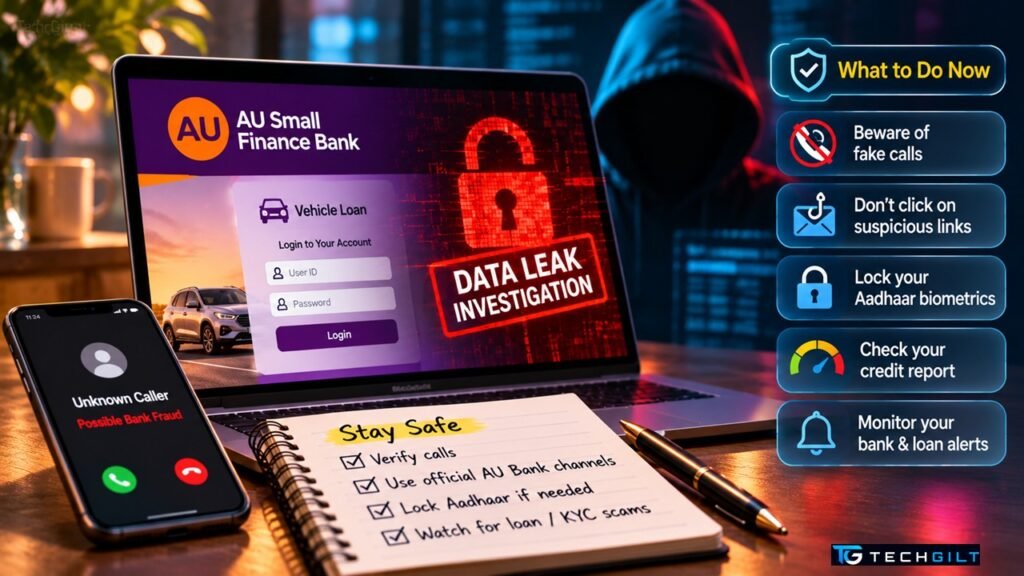
What to Do After the AU Bank Data Leak
If you’re an AU Bank vehicle loan customer or a Vijay Sales customer, take these steps now:
- Be suspicious of every unexpected call or message about your loan, KYC, EMI or account, even if the caller knows your details.
- Never share OTPs, UPI PINs, passwords or card details. Your bank will never ask for them.
- Pay EMIs only through official channels: the bank’s app, internet banking or a branch. Never pay to an account number someone gives you over the phone.
- Lock your Aadhaar biometrics through the mAadhaar app or the UIDAI website, so no one can misuse your fingerprints or face for authentication.
- Check your credit report on CIBIL or another bureau for loans or credit cards you didn’t apply for.
- Change passwords for your banking and shopping apps, and turn on two-factor authentication.
- Report fraud immediately: call 1930, report at cybercrime.gov.in, and inform your bank.
AI Fraud Detection in Banks
Spot and Report UPI Scams
Frequently Asked Questions
Has AU Small Finance Bank been hacked?
AU Bank says it is investigating a potential data leak involving a third-party Salesforce-hosted platform holding limited vehicle loan customer data. It says its own banking systems are unaffected. The hackers’ claims haven’t been independently verified.
Is my money safe after the AU Bank data leak?
The bank says its systems are unaffected and all banking services are running normally. The bigger risk is fraudsters using leaked personal details to trick customers.
What data was exposed in the AU Bank data leak?
The hacker group claims to have KYC records, PAN and Aadhaar details, credit reports, bank statements and loan documents. AU Bank hasn’t confirmed what data, if any, was taken.
How do I lock my Aadhaar biometrics?
You can lock your biometrics through the mAadhaar app or the UIDAI website using your Aadhaar number and an OTP sent to your registered mobile number.
Where do I report fraud in India?
Call the National Cybercrime Helpline on 1930 or report at cybercrime.gov.in, and inform your bank immediately.
Conclusion
The AU Bank data leak claim is a reminder that customer data increasingly sits with third-party software providers, not just inside banks. AU Small Finance Bank says its own systems are safe and it is investigating a platform holding limited vehicle loan data, while the hackers’ claims and the separate Vijay Sales claim remain unverified. Whatever the final findings of the AU Bank data leak investigation, the practical risk for customers is the same: fraudsters armed with personal details. Stay alert to fake calls and messages, never share OTPs, lock your Aadhaar biometrics, and check your credit report regularly.
My take: I believe this incident highlights one of the biggest challenges in digital banking today: the security of customer data held on third-party platforms. Even when a bank’s core systems are safe, exposed personal data can leave customers open to convincing phishing calls, identity theft and fraud. Banks must strengthen vendor security, audit external platforms regularly and communicate openly when a breach is suspected. Customers, in turn, should verify unexpected requests, protect their Aadhaar details and monitor their credit reports. Ultimately, cybersecurity is not the responsibility of banks alone; it depends on the awareness of everyone who uses digital financial services. I would conclude by saying: “Your money may be secure, but protecting your identity is equally important.”
Over to You
Have you received any suspicious calls or messages about your bank loan or KYC recently? Share your experience in the comments to help others stay alert.