A simple guide to the data lakehouse, how it differs from a data warehouse and a data lake, and how BigQuery, Snowflake and Databricks build one
If you work with data, or plan to, you’ve probably heard the word “lakehouse” in job descriptions, cloud courses and vendor announcements. It sounds like jargon, but the idea is simple and is now shaping how almost every company stores and analyses its data. In this guide, we explain what a data lakehouse is, why it became popular, and how the three biggest platforms, Google BigQuery, Snowflake and Databricks, each approach it in 2026.
Quick Answer
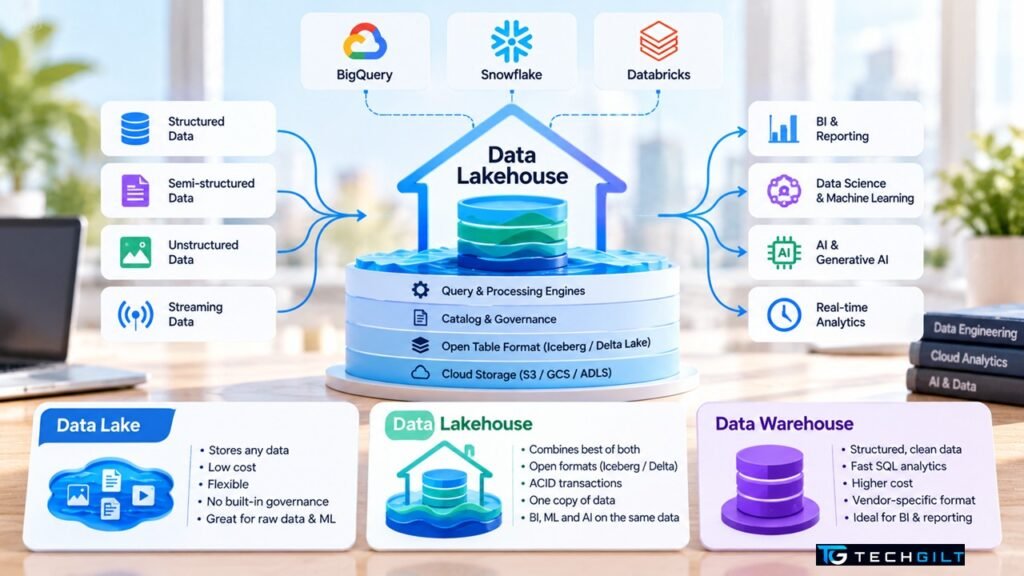
A data lakehouse is a way of storing and managing data that combines the low cost and flexibility of a data lake with the reliability and fast SQL analytics of a data warehouse. Data is kept once, in open file and table formats such as Apache Iceberg or Delta Lake, on cheap cloud storage. Different tools, such as SQL engines, Spark, BI dashboards and AI models, can then read and update that same copy of the data, with one set of security rules. BigQuery, Snowflake and Databricks all support this model today.
First, the Two Older Ideas
To understand the lakehouse, it helps to know the two systems it combines.
The data warehouse
A data warehouse stores clean, structured data in tables, ready for reports and dashboards. It’s fast, reliable and easy to query with SQL. The downside is cost and lock-in: data usually has to be loaded into the vendor’s own storage format, and warehouses are not built for raw files such as images, logs or documents.
The data lake
A data lake stores any kind of data, structured or not, as files on cheap object storage such as Amazon S3, Google Cloud Storage or Azure Data Lake Storage. It’s flexible and inexpensive, which made it popular for big data and machine learning. The problem is control: without proper tables, transactions and governance, many lakes turned into messy “data swamps” where nobody trusted the numbers.
For years, companies ran both: a lake for raw data and data science, and a warehouse for business reports. That meant two copies of the data, extra pipelines to move it, and two sets of security rules.
How a Data Lakehouse Works
A data lakehouse removes that duplication. It is usually built from four layers:
| Layer | What it does | Common examples |
|---|---|---|
| Storage | Holds the data files cheaply | Amazon S3, Google Cloud Storage, Azure Data Lake Storage |
| Open table format | Turns files into reliable tables with transactions, versions and schema changes | Apache Iceberg, Delta Lake, Apache Hudi |
| Catalog | Keeps track of tables, permissions and metadata | Unity Catalog, Snowflake Horizon Catalog, Google Lakehouse runtime catalog |
| Engines | Query and process the data | BigQuery, Snowflake, Databricks SQL, Spark, Trino, DuckDB |
The key part of any data lakehouse is the open table format. Formats such as Iceberg and Delta Lake add warehouse-style features on top of plain files: ACID transactions (changes either fully succeed or fully fail), time travel (query data as it looked last week), and schema evolution (add a column without rewriting everything).
Because the format is open, you’re not tied to a single vendor. One team can query a table in BigQuery while another trains a model on it with Spark, without making a copy.
Data Warehouse vs Data Lake vs Data Lakehouse
| Feature | Data warehouse | Data lake | Data lakehouse |
|---|---|---|---|
| Data types | Mostly structured | Any | Any |
| Storage cost | Higher | Low | Low |
| SQL performance | Excellent | Limited | Very good |
| Transactions (ACID) | Yes | No | Yes |
| Open formats | Usually no | Yes | Yes |
| Best for | BI and reports | Raw data, ML | BI, ML and AI on one copy |
How BigQuery, Snowflake and Databricks Do It in 2026
All three platforms now offer a data lakehouse option built on open table formats and support the Apache Iceberg REST catalog standard, but each starts from a different place.
Google BigQuery: from warehouse to Lakehouse
Google started with BigQuery, a serverless data warehouse, and has steadily opened it up. On April 20, 2026, Google renamed BigLake to Lakehouse, and the BigLake metastore became the Lakehouse runtime catalog, according to Google Cloud’s Lakehouse release notes. BigQuery can now create and manage Iceberg tables, and since September 28, 2026, BigQuery continuous queries can write results straight into Iceberg managed tables. In July, Google also added Snowflake’s Horizon Catalog as a remote catalog provider, in preview.
Snowflake: opening the catalog
Snowflake also began as a warehouse. Its approach centres on Horizon Catalog, which manages governance across Snowflake tables and Iceberg data. In February 2026, Snowflake made it generally available for outside engines such as Apache Spark to read Snowflake-managed Iceberg tables through Horizon Catalog, using the same users, roles and policies, according to Snowflake’s release notes. In August 2026, a preview extended this to externally managed Iceberg tables, accessible from Spark, Trino, DuckDB and PyIceberg.
Databricks: the lakehouse pioneer
Databricks popularised the term “lakehouse” and built its platform around Delta Lake and Unity Catalog, which it open-sourced in 2024. In May 2026, Databricks made Catalog Commits generally available, according to StartupHub.ai. The feature routes every table change through Unity Catalog, so engines like Spark, Flink and Trino stay in sync, and it adds multi-table transactions, a classic warehouse feature.
| Platform | Started as | Main table format | Catalog |
|---|---|---|---|
| Google BigQuery | Data warehouse | Apache Iceberg | Lakehouse runtime catalog |
| Snowflake | Data warehouse | Native tables + Apache Iceberg | Horizon Catalog |
| Databricks | Data lake / Spark | Delta Lake (+ Iceberg support) | Unity Catalog |
The big trend: the three platforms are moving towards each other. Warehouses are opening up to open formats, and the lakehouse pioneer is adding warehouse features. For data lakehouse users, that means more freedom to mix tools on one copy of data.
Why the Data Lakehouse Matters for AI
AI is a big reason the data lakehouse has taken off. Machine learning and AI agents need large amounts of raw and semi-structured data, such as text, logs and documents, but they also need trusted, governed data. A lakehouse provides both in one place, with one set of access rules, so a dashboard, a data scientist and an AI agent can all work from the same source of truth.
Should You Learn About the Data Lakehouse?
If you’re a student, data analyst or engineer, the answer is yes. Here’s a simple learning path:
- Get comfortable with SQL, the language every lakehouse engine speaks.
- Learn one cloud platform well, such as BigQuery, Snowflake or Databricks. All three offer free trials or sandboxes.
- Understand one open table format, especially Apache Iceberg, which all three now support.
- Learn the basics of catalogs and governance, such as permissions, data lineage and data quality.
Also read: Snowflake vs BigQuery
Frequently Asked Questions
What is a data lakehouse in simple words?
It’s a single system that stores all kinds of data cheaply, like a data lake, but lets you query and manage it reliably, like a data warehouse.
Is a data lakehouse better than a data warehouse?
Not always. For pure business reporting on structured data, a warehouse works well. A lakehouse is better when you also need raw data, machine learning or several tools working on the same data.
What is Apache Iceberg?
It’s an open table format that adds transactions, versioning and schema changes to data files on cloud storage. BigQuery, Snowflake and Databricks all support it.
Is BigQuery a data lakehouse?
BigQuery started as a data warehouse, but with Google’s Lakehouse service and Iceberg support, it can now be used as part of a lakehouse.
Who invented the data lakehouse?
Databricks popularised the term around 2020, building its platform on Delta Lake. The idea has since been adopted across the industry.
Conclusion
The data lakehouse combines the best of two worlds: the low cost and flexibility of a data lake, and the reliability and speed of a data warehouse. Open table formats such as Apache Iceberg and Delta Lake make it possible, and in 2026 Google BigQuery, Snowflake and Databricks are all building around them, moving closer to each other every few months. For companies, it means fewer copies of data and fewer pipelines. For learners, it’s one of the most valuable concepts to understand in modern data engineering.
My take: In my view, the data lakehouse is a significant evolution in modern data engineering, because it brings together the flexibility of a data lake and the reliability and analytical power of a data warehouse. I am particularly drawn to the direction taken by open table formats like Apache Iceberg, as they give organisations the freedom to work with different processing and analytics engines without unnecessary data duplication. However, I do not believe a lakehouse is automatically the best solution for every business. My recommendation would depend on an organisation’s specific workloads, governance and administration needs, existing cloud investments and budget.
For those just starting out, I would advise building a strong foundation in SQL and one cloud platform first, before exploring lakehouse architectures and open table formats. The ultimate goal is not merely to adopt a new architecture, but to build a data platform that is reliable, cost-efficient, well-governed and ready for future AI workloads. I would conclude by saying: “A modern data platform should not merely store more data; it should make trusted data easier to access, analyse and use responsibly.”
Over to You
Is your team using a data warehouse, a data lake or a data lakehouse? Share your experience in the comments below.