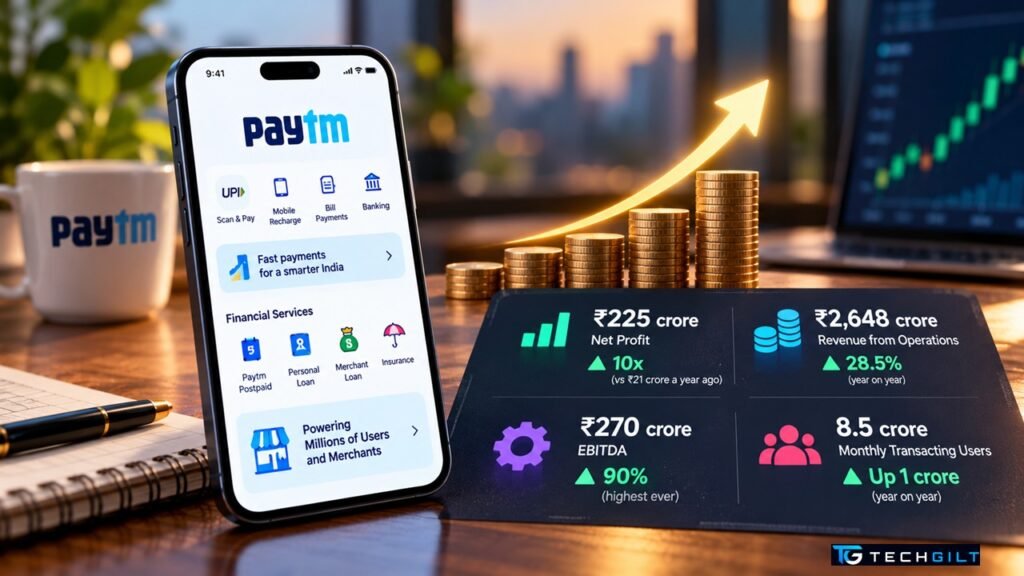
The Paytm Q2 results show profit rising more than ten times to ₹225 crore in the September quarter, with revenue up 28%. Here are the key numbers, what drove the growth and what it means for users and merchants
Paytm’s comeback story continues. One 97 Communications, the company behind Paytm, has reported a net profit of ₹225 crore for the July–September quarter (Q2 FY27), more than ten times the ₹21 crore it earned a year ago. Revenue grew 28% to ₹2,648 crore, and operating profit (EBITDA) hit its highest level ever. Less than three years after the RBI’s action against Paytm Payments Bank, the company is now growing steadily and profitably. Here’s a simple breakdown of the Paytm Q2 results and what they mean for you.
Quick Answer
In the Paytm Q2 results for FY27 (July–September 2026), the company reported a net profit of ₹225 crore, up from ₹21 crore a year earlier. Revenue from operations rose 28.5% to ₹2,648 crore. EBITDA grew 90% to ₹270 crore, its highest ever, with a 10% margin. Monthly transacting users reached 8.5 crore, and 1.64 crore merchants now pay for subscriptions such as soundboxes and card machines. Paytm said it gained consumer UPI market share for the sixth straight quarter.
Paytm Q2 Results: Key Numbers
| Metric | Q2 FY27 | Change |
|---|---|---|
| Net profit | ₹225 crore | Up from ₹21 crore (over 10x) |
| Revenue from operations | ₹2,648 crore | Up 28.5% year on year |
| EBITDA | ₹270 crore | Up 90%, highest ever |
| EBITDA margin | 10% | First double-digit quarter |
| Payment services revenue | ₹1,434 crore | Up 25% |
| Financial services revenue | ₹912 crore | Up 49% |
| Monthly transacting users | 8.5 crore | Up 1 crore |
| Merchant subscriptions | 1.64 crore | Up 27 lakh |
Figures as reported by ANI and Free Press Journal.
What Drove Growth in the Paytm Q2 Results
1. More people using Paytm for UPI
According to the Paytm Q2 results, the app added about 1 crore monthly transacting users in a year, its biggest addition in nearly three years. According to ANI, Paytm’s UPI payment value grew at more than twice the industry rate, and it gained consumer UPI market share for the sixth quarter in a row.
2. Merchants paying for devices
Shops pay Paytm a monthly fee for soundboxes (which announce payments aloud) and card machines. The number of merchants on these subscriptions rose to 1.64 crore.
3. Loans and financial services
Paytm doesn’t lend its own money. It works with banks and NBFCs and earns a fee for distributing their loans. In the Paytm Q2 results, this financial services business grew 49% to ₹912 crore, helped by merchant loans and Paytm Postpaid. More than half of merchant loans went to repeat borrowers.
4. Lower costs with AI
In the Paytm Q2 results, the company credits AI-led efficiencies for bringing indirect expenses down to 46% of revenue, from 52% a year earlier.
Looking at the Numbers Fairly
A few points help put the Paytm Q2 results in context:
- Profit was flat compared with the previous quarter: ₹225 crore against ₹220 crore in April–June, according to Free Press Journal.
- A government incentive has ended: Paytm received money from the Payments Infrastructure Development Fund (PIDF) until December 2025. On a comparable basis, excluding it, operating revenue grew 33%.
- A pending regulatory matter: auditors noted a pending FEMA show-cause notice relating to alleged contraventions of about ₹611 crore.
- New investments: Paytm plans to invest up to ₹500 crore each in Paytm Cloud Technologies and Paytm Singapore.
What the Paytm Q2 Results Mean for You
For users: the Paytm Q2 results show a financially stronger company, which supports continued investment in its app, UPI features and fraud protection.
For merchants: the company expects the proposed merchant discount rate (MDR) on larger UPI payments, if implemented, to slightly improve its payment margins. Small merchants should watch for any changes to fees.
For investors: strong profit growth is positive, but past results don’t guarantee future returns. This article is for information only and is not investment advice.
UPI Merchant Fee Delayed
AI Fraud Detection in Banks
Frequently Asked Questions
What do the Paytm Q2 results show?
Paytm reported a net profit of ₹225 crore for July–September 2026, up from ₹21 crore a year earlier, with revenue up 28.5%.
How much did Paytm’s revenue grow?
In the Paytm Q2 results, revenue from operations rose 28.5% year on year to ₹2,648 crore.
How many people use Paytm every month?
The Paytm Q2 results show 8.5 crore monthly transacting users, up 1 crore from a year earlier.
What drove the Paytm Q2 results?
Higher UPI usage, more merchant device subscriptions, strong growth in loan distribution and lower costs, partly from AI, drove the improvement.
Is Paytm safe to use?
Paytm remains a licensed payment app for UPI and other services. As with any app, protect your UPI PIN and OTPs and never share them with anyone.
Conclusion
The Paytm Q2 results show a company that has steadily rebuilt after its 2024 setback. Profit rose more than tenfold to ₹225 crore, revenue grew 28%, EBITDA reached a record ₹270 crore, and Paytm added 1 crore monthly users while gaining UPI market share. Growth in merchant subscriptions and loan distribution, plus AI-driven cost savings, powered the improvement. Flat quarter-on-quarter profit, the end of a government incentive and a pending regulatory notice are worth watching, but overall the Paytm Q2 results show the company is firmly back on a growth path.
My take: In my view, the Paytm Q2 results are an encouraging step in the company’s recovery, and they show the value of rebuilding a business through strong operations, better customer relationships and disciplined cost management. Higher profits, a growing merchant base and gains in financial services suggest that Paytm is no longer relying only on digital payments for its revenue. Its use of AI is also noteworthy, because applying AI effectively can help businesses improve productivity and control costs.
However, I would not judge a company’s future only on impressive year-on-year profit growth. Investors should also look at the sustainability of its earnings, cash flow, regulatory developments and its ability to keep growing in a competitive digital payments market. For users and merchants, the priorities should be reliable service, transparent fees and strong fraud protection. Ultimately, a successful turnaround is not defined by one strong quarter; it is about building trust and delivering steady performance over time. I would conclude by saying: “A strong quarter can signal a comeback, but consistent performance is what builds lasting trust.”
Over to You
Do you use Paytm for UPI payments, or do you prefer PhonePe or Google Pay? Share your experience in the comments below.