NPCI postpones the 0.4% charge on large UPI payments until after Diwali. Here’s who will pay, how much, and what stays free
The UPI merchant fee that was due to start on October 15 has been put on hold. The National Payments Corporation of India (NPCI), which runs UPI, has deferred the new 0.4% charge on larger merchant payments until after Diwali, giving shopkeepers, restaurants and online sellers relief during the busiest shopping season of the year. Here’s what the fee is, who it applies to, and what it means for you when you pay by UPI.
Quick Answer
The UPI merchant fee is a 0.4% charge, known as the merchant discount rate (MDR), on merchant UPI payments above ₹2,000. It was meant to start on October 15, 2026, but NPCI has deferred it until after Diwali (November 8), without announcing a new date. Customers don’t pay this fee: merchants pay it, and they’re not allowed to pass it on. Payments of ₹2,000 or less, person-to-person transfers and small merchants receiving up to ₹1 lakh a month stay free.
Why the UPI Merchant Fee Was Delayed
According to The Week, the decision was taken by NPCI’s UPI and Services Steering Committee “keeping in mind the festive season”. Diwali falls on November 8 this year, and the weeks before it are the peak period for retail, restaurants and e-commerce.
NPCI says the new date will be notified separately. Some reports expect the fee to begin in the second week of November, but nothing has been officially confirmed yet. Opposition leaders and trader groups had also criticised the plan, saying it could hurt small businesses.
How the UPI Merchant Fee Works
The UPI merchant fee was announced in September. According to TechCrunch, here’s how it is structured:
| Payment type | Charge to the merchant |
|---|---|
| Merchant payment of ₹2,000 or less | Free |
| Merchant payment above ₹2,000 | 0.4% |
| Payment of ₹75,000 or more | Capped at ₹300 |
| Railways, telecom, insurance and fuel (above ₹2,000) | Flat ₹5 per payment |
| Capital-market payments | 0.02%, capped at ₹300 |
| Person-to-person transfers | Free |
| Small merchants (up to ₹1 lakh a month via UPI) | Exempt |
Reports say 18% GST will be added on top of the fee.
Examples: a ₹2,500 payment would cost the merchant ₹10, a ₹5,000 payment ₹20, and a ₹10,000 payment ₹40.
Two details are easy to miss:
- The ₹2,000 limit applies per payment, not to a shop’s daily total. Ten payments of ₹1,500 each are all free.
- Small merchants can move up a category. A small merchant whose UPI collections cross ₹1 lakh a month for three months in a row will be treated as a large merchant.
Do Customers Have to Pay?
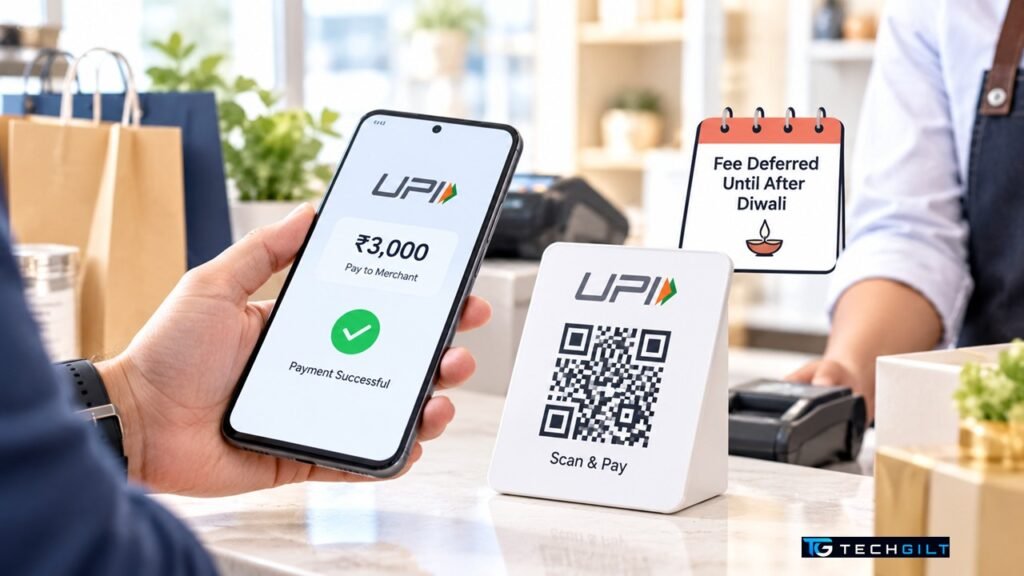
No. The UPI merchant fee is paid by the merchant, and NPCI says merchants cannot pass it on to customers as an extra charge. When you scan a QR code and pay ₹3,000 at a shop, you still pay exactly ₹3,000.
However, trader groups worry that some businesses may raise prices slightly, or push customers towards cash or other payment methods for larger purchases. If a shop asks you for an extra “UPI charge”, it is not supposed to.
Why UPI Needs a Fee Now
Merchant fees on UPI were removed in January 2020 to encourage digital payments, and the plan clearly worked. In August 2026 alone, UPI processed 24.51 billion transactions worth about ₹29.9 trillion.
But running a network this large isn’t free. NPCI estimates the yearly cost of servers, fraud prevention and customer support at around ₹20,000 crore. Until now, the government has subsidised part of this cost. The new UPI merchant fee is meant to share that burden, and part of the money is expected to fund cybersecurity, fraud prevention and the expansion of digital payments in smaller cities and rural areas.
The impact of the UPI merchant fee is also limited: more than 95% of UPI merchant payments are ₹2,000 or less, so most everyday transactions will stay free. For comparison, merchants usually pay 1.5% to 2.5% on credit card payments, so 0.4% is still much lower.
What It Means for You
- As a customer: nothing changes. Keep paying by UPI as usual, with no extra charge.
- As a small shopkeeper: if your UPI collections are under ₹1 lakh a month, you’re exempt, even for payments above ₹2,000.
- As a larger business: you get a few extra weeks before the UPI merchant fee starts. Use this time to check your monthly UPI volumes and plan for the cost.
- For everyone: sending money to family or friends stays completely free.
UPI isn’t the only big Indian tech business story this month: Bengaluru’s defence-tech firm Tonbo Imaging also had a blockbuster stock-market debut, as explained in our Tonbo Imaging IPO Listing article.
Also read: OpenAI Shelves GPT-6.1 Astra
Also read: CERT-In Warns of API Attacks
Frequently Asked Questions
When will the UPI merchant fee start?
It was due on October 15, 2026, but NPCI has deferred it until after Diwali. A new date hasn’t been announced yet.
How much is the UPI merchant fee?
It is 0.4% on merchant payments above ₹2,000, capped at ₹300 for payments of ₹75,000 or more. Some categories, such as fuel and railways, pay a flat ₹5.
Will I have to pay extra when I pay a shop by UPI?
No. The merchant pays the fee and isn’t allowed to pass it on to customers.
Is sending money to friends and family by UPI still free?
Yes. Person-to-person transfers are not covered by the fee.
Which merchants are exempt from the UPI merchant fee?
Small merchants receiving up to ₹1 lakh a month through UPI are exempt, and payments of ₹2,000 or less are free for all merchants.
Conclusion
The delay to the UPI merchant fee gives India’s merchants a little breathing room during the festive season, but the charge is still coming, most likely soon after Diwali. For customers, nothing changes: UPI payments stay free, and shops can’t add the fee to your bill. For businesses, the fee is small compared with card charges, and most everyday payments under ₹2,000 remain free. The bigger question is whether this marks the start of a more sustainable model for one of the world’s largest digital payment systems.
My take: In my view, UPI should remain free for everyday customers, because its greatest strength lies in its simplicity, reliability and accessibility for routine payments. At the same time, a payment network that handles billions of transactions, every day and every minute, needs a sustainable way to fund its infrastructure, cybersecurity and fraud prevention. That’s why a small UPI merchant fee on large merchants could be reasonable, provided that small businesses are adequately protected and the revenue is transparently reinvested to improve the system. Customers should never feel that they are being penalised or asked to pay extra just for choosing UPI.
The real success of this policy will depend on whether it makes India’s digital payments ecosystem more sustainable without weakening the public trust and convenience that made UPI so popular in the first place. In the long run, balancing affordability for users, fairness for merchants and transparency in governance is what will keep UPI a cornerstone of India’s digital economy. I would conclude by saying: “Keep digital payments free for the common person, make the system sustainable for the future, and ensure that small businesses are not left carrying an unfair burden.”
Over to You
Do you think a 0.4% fee on larger UPI payments is fair, or should UPI stay completely free for merchants? Share your thoughts in the comments below.