GPT-6 Astra, GPT-6.1 Sol, GPT-6 Luna and Codex are coming to Google Cloud. Here’s what was announced, how businesses can use them, and why it matters
Until recently, the AI race looked simple: OpenAI worked with Microsoft, Anthropic worked with Amazon and Google, and Google pushed its own Gemini models. That picture has now changed. On October 21, 2026, OpenAI and Google announced that OpenAI models on Google Cloud will be available to enterprise customers, alongside Gemini and Anthropic’s Claude. It means a Google Cloud customer can now pick from the three leading families of closed AI models on one platform. Here’s what the deal includes and what it means for businesses and developers.
Quick Answer
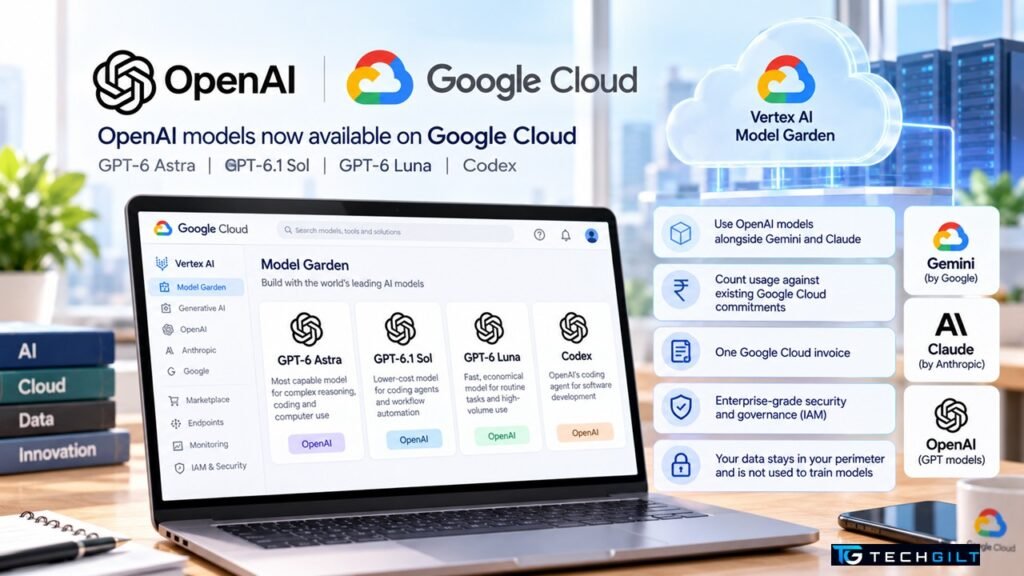
On October 21, 2026, OpenAI and Google announced that OpenAI models on Google Cloud are rolling out in private preview through Model Garden (part of Vertex AI) for selected enterprise customers. The three models are GPT-6 Astra, GPT-6.1 Sol and GPT-6 Luna, and OpenAI’s coding agent Codex is also coming. Customers can buy the models through Google Cloud Marketplace, count usage against their existing Google Cloud commitments, and get one Google Cloud invoice. Google says prompts and outputs stay inside the customer’s data perimeter and are not used to train models. General availability is expected “in the coming weeks.”
What Was Announced
According to The Next Web, OpenAI and Google jointly announced OpenAI models on Google Cloud. The key points:
- Three OpenAI models are rolling out in private preview in Google Cloud’s Model Garden, starting with selected enterprise customers.
- Codex, OpenAI’s coding agent, can already be connected to Google’s platform by developers.
- OpenAI models are “coming soon” to Google Antigravity (Google’s agent-based coding environment) and the Gemini Agent.
- General availability is planned “in the coming weeks.”
OpenAI president Greg Brockman called the partnership “an important step in making our most capable models and Codex available where customers are already building.” Google Cloud CEO Thomas Kurian said Google is focused on giving customers “a broad selection of models, including those from OpenAI.”
The Three OpenAI Models on Google Cloud
| Model | Best for |
|---|---|
| GPT-6 Astra | OpenAI’s most capable model, for hard coding, research, computer-use and reasoning tasks |
| GPT-6.1 Sol | Lower-cost model for coding agents and workflow automation |
| GPT-6 Luna | Fast, economical model for routine tasks and high-volume use |
Model roles as described by Data Studios. Google Cloud pricing for these models has not been published yet.
How Businesses Can Use OpenAI Models on Google Cloud
For companies already on Google Cloud, the main benefit is convenience:
- One platform: use OpenAI models from Model Garden and Google Cloud APIs, next to Gemini and Claude.
- Existing budgets: usage can count towards existing Google Cloud spending commitments, so teams don’t need a separate OpenAI contract.
- One invoice: all usage appears on the Google Cloud bill.
- Familiar controls: access is managed through Google Cloud’s existing IAM (identity and access management), auditing and governance tools.
For large enterprises, this matters a lot. Signing a new AI vendor often takes months of legal, security and procurement reviews. Buying through a cloud provider they already trust can cut that to days.
What About Data Privacy and Security?
Google says OpenAI models on Google Cloud run on dedicated Google Cloud infrastructure, and that customer prompts and outputs stay inside the customer’s data perimeter and are never used to train models.
Data Studios notes that features such as Zero Data Retention and Confidential Compute are described as coming later, not available at launch. As always, enterprises should check these commitments against their own contracts and compliance needs before moving sensitive data.
Why This Deal Matters
1. Google Cloud now offers all three leading model families
Google says it is the only hyperscale cloud offering the three leading closed AI model families: Gemini, Anthropic’s Claude and now OpenAI’s GPT models. With OpenAI models on Google Cloud, Google now has a strong “one-stop shop” pitch.
2. OpenAI is now on all three big clouds
Amazon Web Services began hosting OpenAI models in April 2026, after Microsoft’s exclusive licence ended, and OpenAI added its agents to Amazon Bedrock last month, according to The Next Web. With this deal, OpenAI models are now available across Microsoft Azure, AWS and Google Cloud. OpenAI says Microsoft remains its primary cloud partner.
3. Rivals are becoming partners
OpenAI and Google compete head-on: ChatGPT against Gemini, and Codex against Google’s own coding tools. Yet both gain from this deal. OpenAI reaches Google Cloud’s enterprise customers, and Google earns revenue on model usage through its cloud. As analyst Mike Leone of Moor Insights & Strategy told Axios, Gemini “now has to win those customers with OpenAI sitting right next to it.”
4. The cloud race is heating up
Google Cloud’s revenue growth accelerated to about 82% in the second quarter, compared with 37% for Amazon and 42% for Microsoft, according to CNBC figures cited by The Next Web. Adding OpenAI models on Google Cloud strengthens Google’s position just before all three companies report quarterly results next week.
What It Means for Indian Businesses and Developers
Many Indian banks, fintechs, retailers and IT services firms already run workloads on Google Cloud. For them, OpenAI models on Google Cloud could make it easier to:
- Compare models side by side (Gemini, Claude and GPT) for the same task, and pick the best mix of cost and quality
- Avoid managing separate AI contracts and billing
- Keep AI usage under existing security and governance controls
Note: OpenAI and Google have not announced India-specific availability, pricing or data-residency details. Indian companies with strict data-localisation needs should wait for region details before planning production use.
For developers and data engineers, skills in Vertex AI and Model Garden now cover even more models, which makes Google Cloud skills more valuable.
What Happens Next
- General availability of OpenAI models on Google Cloud: expected “in the coming weeks,” with no firm date yet
- Pricing: Google Cloud rates for the three models are still to be published
- More integrations: OpenAI models in Google Antigravity and the Gemini Agent
- Earnings: Google, Amazon and Microsoft report quarterly results next week, which may show how much AI is driving cloud growth
Also read: Gemini 4 Argon Launched
Frequently Asked Questions
Which OpenAI models are coming to Google Cloud?
The OpenAI models on Google Cloud are GPT-6 Astra, GPT-6.1 Sol and GPT-6 Luna, plus OpenAI’s coding agent Codex.
Can anyone use OpenAI models on Google Cloud now?
Not yet. They are in private preview for selected enterprise customers. General availability is expected in the coming weeks.
How do companies pay for OpenAI models on Google Cloud?
Through Google Cloud Marketplace. Usage can count towards existing Google Cloud commitments and appears on the Google Cloud invoice.
Will Google use customer data to train models?
Google says prompts and outputs stay inside the customer’s data perimeter and are not used to train models.
Is OpenAI leaving Microsoft?
No. OpenAI says Microsoft remains its primary cloud partner. Its models are now also available on AWS and Google Cloud.
Conclusion
The arrival of OpenAI models on Google Cloud is a big shift in the AI industry. Google Cloud can now offer Gemini, Claude and GPT models on one platform, while OpenAI’s models are available across all three major clouds. For enterprises, it means more choice, simpler buying through existing cloud budgets, and familiar security controls, though pricing, regions and some privacy features are still to come. For the industry, it shows that in the AI race, even the fiercest rivals are willing to work together when customers demand choice.
My take: I believe the future of AI is moving towards choice, rather than relying on a single model provider. With OpenAI models on Google Cloud, businesses can compare GPT, Gemini and Claude within a familiar cloud environment, with simpler integration, billing and governance. However, companies should not choose a model simply because it is powerful or popular. Instead, they should evaluate accuracy, cost, speed, security and how well it suits their specific business tasks. For Indian enterprises, meeting data residency requirements and other regulations remains critical.
In my view, the real value of enterprise AI lies not in using the greatest number of models, but in selecting the right model for the right task while keeping data secure and costs under control. I would conclude by saying: “The future of AI is not about choosing one model for everything; it is about choosing the right model for each task, without compromising security, quality or cost.”
Over to You
Would your company prefer one AI model provider, or the freedom to choose between Gemini, Claude and GPT on one cloud? Share your thoughts in the comments below.