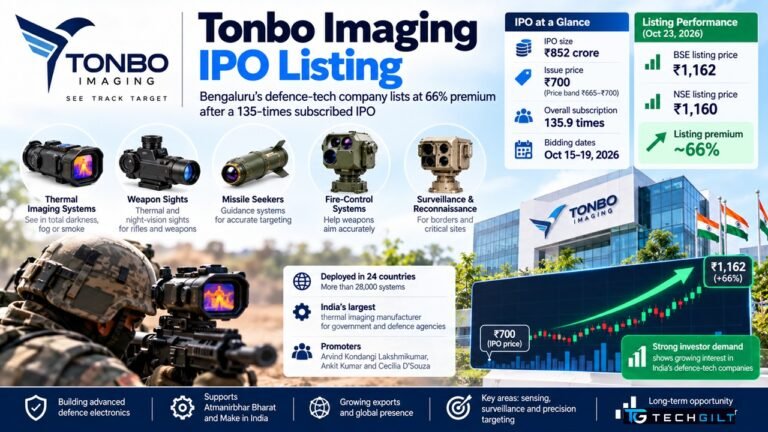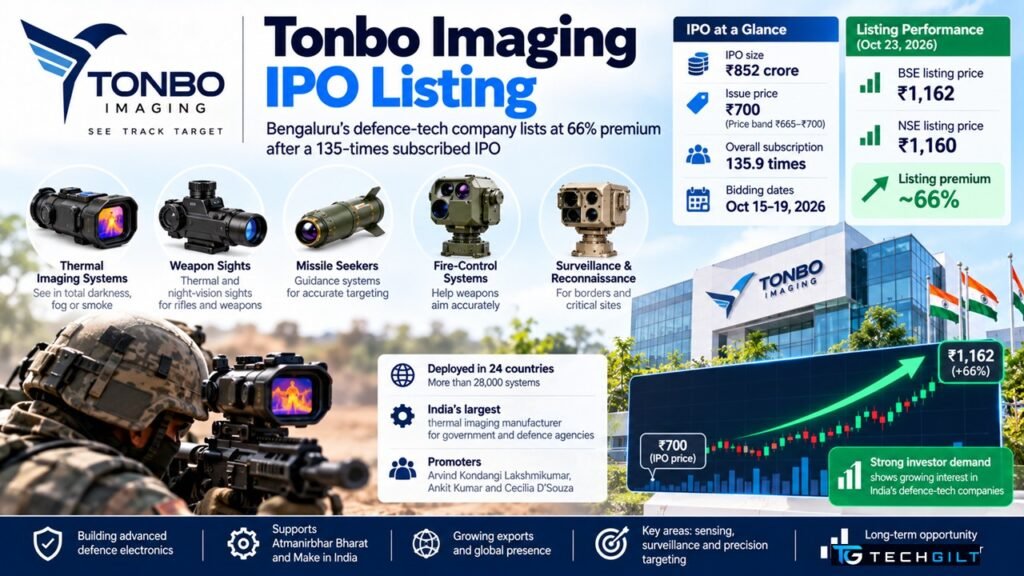
Bengaluru’s defence-tech company listed at a 66% premium after a 135-times subscribed IPO. Here’s what Tonbo makes, how the IPO went, and what investors should watch
India’s defence-technology companies are having a moment. On October 23, 2026, Bengaluru-based Tonbo Imaging made a blockbuster stock-market debut, listing at a 66% premium to its issue price after its IPO drew bids worth more than 135 times the shares on offer. The Tonbo Imaging IPO is one of the strongest listings of the year, and it shows how much investors now believe in Indian companies building advanced defence electronics. Here’s what Tonbo does, how the Tonbo Imaging IPO performed, and the points to keep in mind beyond the listing-day excitement.
Note: this article is for information only and is not investment advice. Please consult a SEBI-registered financial adviser before investing.
Quick Answer
The Tonbo Imaging IPO was a ₹852 crore issue, priced at ₹700 per share (price band ₹665–₹700), open from October 15 to 19, 2026. It was subscribed 135.9 times overall, with qualified institutional buyers bidding 293.56 times. Shares listed on October 23 at ₹1,162 on BSE and ₹1,160 on NSE, a premium of about 66%, and closed around ₹1,133 on the BSE. The issue was entirely an offer for sale, so the money went to selling shareholders, not the company. Tonbo makes thermal imaging systems, weapon sights, missile seekers and fire-control systems, deployed in 24 countries.
Tonbo Imaging IPO at a Glance
| Detail | Tonbo Imaging IPO |
|---|---|
| IPO size | About ₹852 crore |
| Type | 100% offer for sale (no fresh issue) |
| Price band | ₹665–₹700 per share |
| Issue price | ₹700 |
| Lot size | 21 shares (₹14,700 minimum) |
| Bidding dates | October 15–19, 2026 |
| Overall subscription | 135.9 times |
| Listing date | October 23, 2026 |
| Listing price | ₹1,162 (BSE), ₹1,160 (NSE) |
| Listing gain | About 66% |
Figures from Business Standard and Chittorgarh.
What Does Tonbo Imaging Do?
Tonbo Imaging is a Bengaluru-based defence electronics company that designs, develops and manufactures systems that help armed forces see, track and target in difficult conditions, such as at night, in fog or in smoke. Its products include:
- Thermal imaging systems: cameras that detect heat, so soldiers can see people and vehicles in total darkness
- Weapon sights: thermal and night-vision sights for rifles and other weapons
- Missile seekers: the “eyes” that guide a missile to its target
- Fire-control systems: systems that help weapons aim accurately
- Surveillance and reconnaissance systems for borders and critical sites
According to Chittorgarh, Tonbo has deployed more than 28,000 systems for customers in 24 countries, and describes itself as India’s largest thermal imaging manufacturer for government and defence agencies. Its promoters are Arvind Kondangi Lakshmikumar, Ankit Kumar and Cecilia D’Souza.
How the Tonbo Imaging IPO Performed
Huge demand from big investors
The Tonbo Imaging IPO saw strong demand across investor groups, according to Business Standard:
| Investor category | Subscription |
|---|---|
| Qualified institutional buyers (QIBs) | 293.56 times |
| Non-institutional investors (NIIs) | 170.94 times |
| Employees | 54.31 times |
| Retail investors | 31.07 times |
| Overall | 135.9 times |
The IPO received over 55 lakh applications. Before it opened, Tonbo raised ₹255.36 crore from anchor investors, including SBI, ICICI Prudential, HDFC and Kotak Mahindra mutual funds, Goldman Sachs and BlackRock.
A strong debut
Shares listed at ₹1,162 on BSE, 66% above the ₹700 issue price, and ₹1,160 on NSE. They closed the day around ₹1,133, still about 62% above the issue price, according to StartupTalky. An investor who received one lot of 21 shares at ₹14,700 would have seen it valued at about ₹24,400 at the BSE listing price.
Why Investors Are Excited About Defence Tech
The Tonbo Imaging IPO reflects a bigger trend. India is pushing to make more of its defence equipment at home under the Atmanirbhar Bharat and Make in India initiatives, and is also trying to export more defence products. Companies with their own technology in critical areas, such as thermal imaging and missile guidance, are seen as long-term beneficiaries.
Investors also value Tonbo’s deep technology. Designing sensors and guidance systems takes years of research and is hard to copy, which can give such companies a lasting advantage.
On the same day, another venture-backed company, manufacturing platform Zetwerk, also listed on the NSE at about 5.5% above its issue price, according to StartupTalky, showing continued investor appetite for Indian start-up IPOs.
Points to Watch Beyond Listing Day
A strong listing doesn’t guarantee strong returns later. A few points stand out from Tonbo’s IPO documents, as summarised by Chittorgarh:
- No money for the company: the Tonbo Imaging IPO was entirely an offer for sale. Existing shareholders sold shares, and the company didn’t raise fresh capital for growth.
- Falling recent results: total income fell from ₹474.39 crore in FY25 to ₹369.94 crore in FY26, and profit after tax fell from ₹72.76 crore to ₹50.88 crore. In Q1 FY27 (April–June 2026), Tonbo reported a loss of ₹17.74 crore.
- High valuation: at the issue price, the P/E ratio was about 79 times earnings, and the stock now trades higher still.
- Lumpy defence orders: defence revenue depends on large government contracts, which can be delayed, so results may vary sharply from quarter to quarter.
- Low promoter holding: promoters held about 14.56% after the IPO.
These don’t make Tonbo a bad company, but they’re worth understanding before buying shares after a big listing-day jump.
What It Means for Indian Startups
For India’s start-up ecosystem, the Tonbo Imaging IPO is an encouraging signal:
- Deep-tech can win in public markets: investors are willing to back companies built on hardware and research, not just consumer apps.
- Defence is an opportunity: more founders and investors are likely to explore defence, aerospace and dual-use technologies.
- Exits are possible: strong listings give early investors a way to cash out, which encourages more funding for the next generation of start-ups.
Also read: OpenAI Models on Google Cloud
Frequently Asked Questions
What was the Tonbo Imaging IPO issue price?
The issue price was ₹700 per share, at the top of the ₹665–₹700 price band.
What was the Tonbo Imaging IPO listing price?
Shares listed at ₹1,162 on BSE and ₹1,160 on NSE on October 23, 2026, about 66% above the issue price.
How many times was the Tonbo Imaging IPO subscribed?
It was subscribed 135.9 times overall, with qualified institutional buyers bidding 293.56 times.
What does Tonbo Imaging make?
Defence electronics, including thermal imaging systems, weapon sights, missile seekers and fire-control systems, deployed in 24 countries.
Did Tonbo Imaging raise new money through the IPO?
No. The IPO was entirely an offer for sale, so the proceeds went to selling shareholders.
Conclusion
The Tonbo Imaging IPO was one of 2026’s standout listings: 135.9 times subscribed, backed by top mutual funds and global investors, and listed at a 66% premium. It highlights growing confidence in Indian defence-tech companies that build their own advanced technology. At the same time, falling recent results, a first-quarter loss, a fully secondary issue and a high valuation are reminders that a great listing day is only the beginning. For India’s start-up ecosystem, though, the message is clear: deep-tech companies solving hard problems can attract serious investor interest.
My take: I believe the successful Tonbo Imaging IPO is an encouraging sign for India’s deep-technology and defence start-up ecosystem. It shows that investors are willing to look beyond consumer apps and software businesses and back specialised technologies developed by Indian companies. However, I would never judge an investment only by its subscription figures or listing-day gains. In the past, several heavily hyped IPOs across the market have left retail investors with losses once the excitement faded.
Instead, investors should examine revenue and profit trends, the order pipeline, cash flow, valuation and the company’s ability to turn its proprietary technology into sustainable earnings. It is also significant that Tonbo’s IPO was entirely an offer for sale, so the company did not raise any new capital through this issue.
In my view, the long-term potential of India’s defence-tech sector is exciting, but successful investing requires patience, thorough research and disciplined risk management. A promising company and an attractively valued stock are not always the same thing. A successful listing is an event; sustainable business performance is a journey. Before investing in a newly listed company, look beyond the headlines, and never assume a share will keep rising simply because it listed at a premium. I would conclude by saying: “Don’t invest in the excitement of a listing day; invest only when you understand the business, its risks and the price you are paying.”
Over to You
Did you apply for the Tonbo Imaging IPO, and do you think defence-tech will be India’s next big start-up story? Share your thoughts in the comments below.