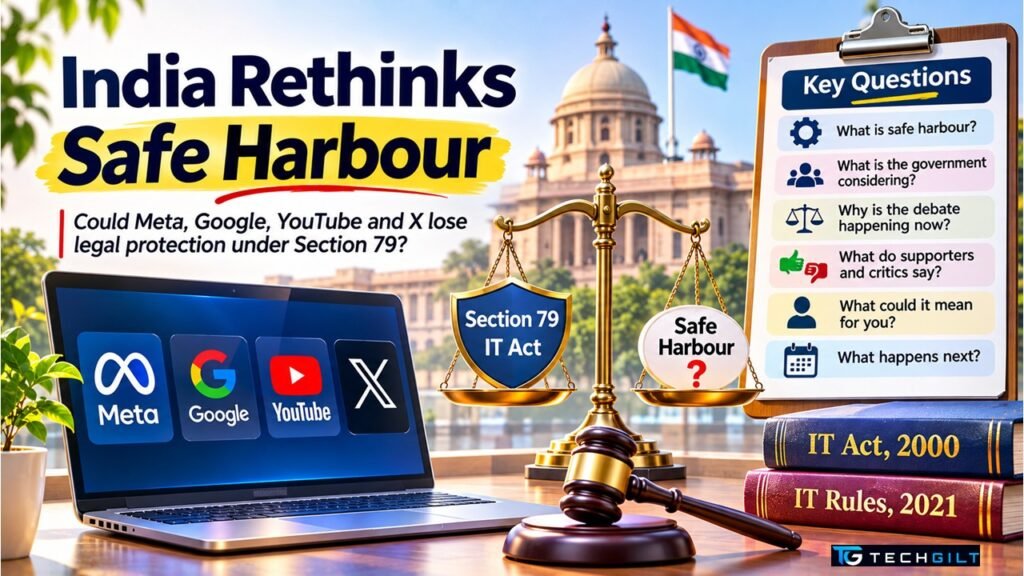
The Centre is considering limiting safe harbour protection for Meta, Google, YouTube and X under Section 79 of the IT Act. Here’s what safe harbour means, what could change and what it may mean for you
Social media companies in India may soon face a big change in how the law treats them. According to reports by The Indian Express and Business Standard on November 4 and 5, 2026, the Ministry of Electronics and Information Technology (MeitY) has begun discussing whether platforms such as Facebook, Instagram, YouTube and X should keep their safe harbour protection. This protection currently shields them from legal liability for most content their users post. The discussions are at an early, exploratory stage, and no decision has been taken. Here’s what’s happening and why it matters.
Quick Answer
Safe harbour is a legal protection under Section 79 of the IT Act, 2000 that shields online platforms from liability for content posted by users, as long as they follow due diligence rules and remove unlawful content when required. The government is now examining whether to limit safe harbour to services that only carry information, such as internet service providers, telecom operators and peer-to-peer messaging apps, and not to social media platforms that use algorithms to rank and recommend content. Any such change would likely need an amendment to the IT Act and approval from Parliament.
What Is Safe Harbour?
Think of a courier company. If someone sends something illegal in a parcel, the courier company isn’t usually blamed, because it only carried the parcel. Safe harbour applies a similar idea to the internet.
Under Section 79, an “intermediary” (a platform that hosts or transmits other people’s content) is not held legally responsible for every post, video or comment its users share. But the protection is conditional. Platforms must:
- Follow due diligence rules under the IT Rules, 2021
- Remove unlawful content when ordered by a court or the government
- Not take part in, encourage or help with the unlawful act
If a platform fails these conditions, it can already lose this protection for that content.
What the Government Is Considering
According to MediaNama’s summary of the Business Standard report, the proposal follows concerns that platforms actively influence what users see. The core argument is simple: if an algorithm decides which posts reach millions of people, the platform is no longer just a passive carrier.
Based on the reports, the ideas under discussion include:
- Restricting the protection to ISPs, telecom operators and peer-to-peer messaging platforms.
- Treating social media platforms differently if they rank, recommend or amplify content.
- Requiring platforms to inform authorities before major product changes that affect user safety.
Officials have not published any draft, and MeitY has not formally notified any amendment.
Why the Safe Harbour Debate Is Happening Now
This question has been building for months:
- August 2026: a parliamentary standing committee on IT met MeitY, the Home Ministry and platforms including Meta, Google, X, YouTube and Snapchat. It recommended withdrawing protection from platforms that fail to comply with Indian law.
- Meta tensions: the committee clashed with Meta over the removal of a video of the Prime Minister, and the government raised concerns about child sexual abuse material (CSAM) and deepfakes.
- Supreme Court: the court has separately questioned whether existing protections are enough to tackle CSAM on social media.
- November 6, 2026: IT Minister Ashwini Vaishnaw placed the responsibility for preventing online harm, including digital arrest scams, on social media companies, as reported by Open Magazine.
What Supporters and Critics Say
Those in favour of change argue that platforms earn money by deciding what content spreads, so they should share responsibility when that content causes harm. They point to deepfakes, CSAM, online scams and misinformation as problems that algorithms can amplify faster than any human moderator can catch.
Critics, including the digital rights group SFLC.in, warn that removing this protection could push platforms to remove lawful content to avoid legal risk. They argue this could affect free speech, and they cite the Supreme Court’s 2015 Shreya Singhal judgment, which shaped how intermediary liability works in India today. Some also worry about the cost for smaller Indian startups that also use algorithms.
What It Could Mean for You
Nothing changes yet. But if the protection is restricted in future:
- Stricter moderation: platforms may remove posts faster and more often, including borderline content.
- Changes to feeds: recommendation features could be redesigned or limited in India.
- More accountability: platforms may act faster on deepfakes, scams and harmful content.
- Messaging apps: if the reports are accurate, private, peer-to-peer messaging may stay protected.
What Happens Next
For now, this is a discussion inside the government, not a law. Any major change would likely need a bill in Parliament, public debate and, possibly, consultation with industry and civil society. The platforms have not publicly responded in detail to the latest reports.
How to Spot Deepfakes
Bitchat Blocked in India
Frequently Asked Questions
What is safe harbour in India?
Safe harbour is a legal protection under Section 79 of the IT Act, 2000. It protects online platforms from liability for content posted by users, as long as they follow due diligence rules and remove unlawful content when required.
Is the government removing safe harbour for social media?
Not yet. MeitY is reportedly discussing whether to limit it for social media platforms that use algorithms. No decision has been made, and any major change would likely need Parliament’s approval.
Which platforms could be affected?
Reports mention Facebook, Instagram, YouTube and X. Internet service providers, telecom operators and peer-to-peer messaging platforms may keep protection.
Why is the government considering this?
Officials argue that platforms using algorithms actively decide what users see. Concerns about deepfakes, child abuse material, online scams and compliance with Indian law have also driven the debate.
Will WhatsApp be affected?
The reports suggest that peer-to-peer messaging platforms may continue to have protection, but no final details have been published.
Conclusion
The safe harbour debate goes to the heart of how India regulates the internet. The government argues that platforms which rank and amplify content should take more responsibility for it. Critics warn that removing protection could lead to over-censorship and hurt free speech. For now, the proposal is exploratory, and any change would need Parliament’s approval. Indian users should watch this closely, because the outcome could change what they see, post and share on social media.
My take: I believe social media platforms should be more accountable for content they promote, particularly deepfakes, financial fraud and harmful misinformation. However, removing safe harbour protections could encourage excessive censorship, with platforms deleting legitimate content to avoid legal risks. India needs a balanced framework that protects citizens from online harm while safeguarding freedom of expression. Transparency, independent oversight and clear legal safeguards are essential for fair content moderation. While technology companies must be held accountable, they should not be given unchecked power to censor content irresponsibly. I would like to conclude by saying: “A safer internet must protect people from harmful content without silencing their freedom to speak.”
Over to You
Should social media platforms be held responsible for what their algorithms recommend? Share your view in the comments below.